
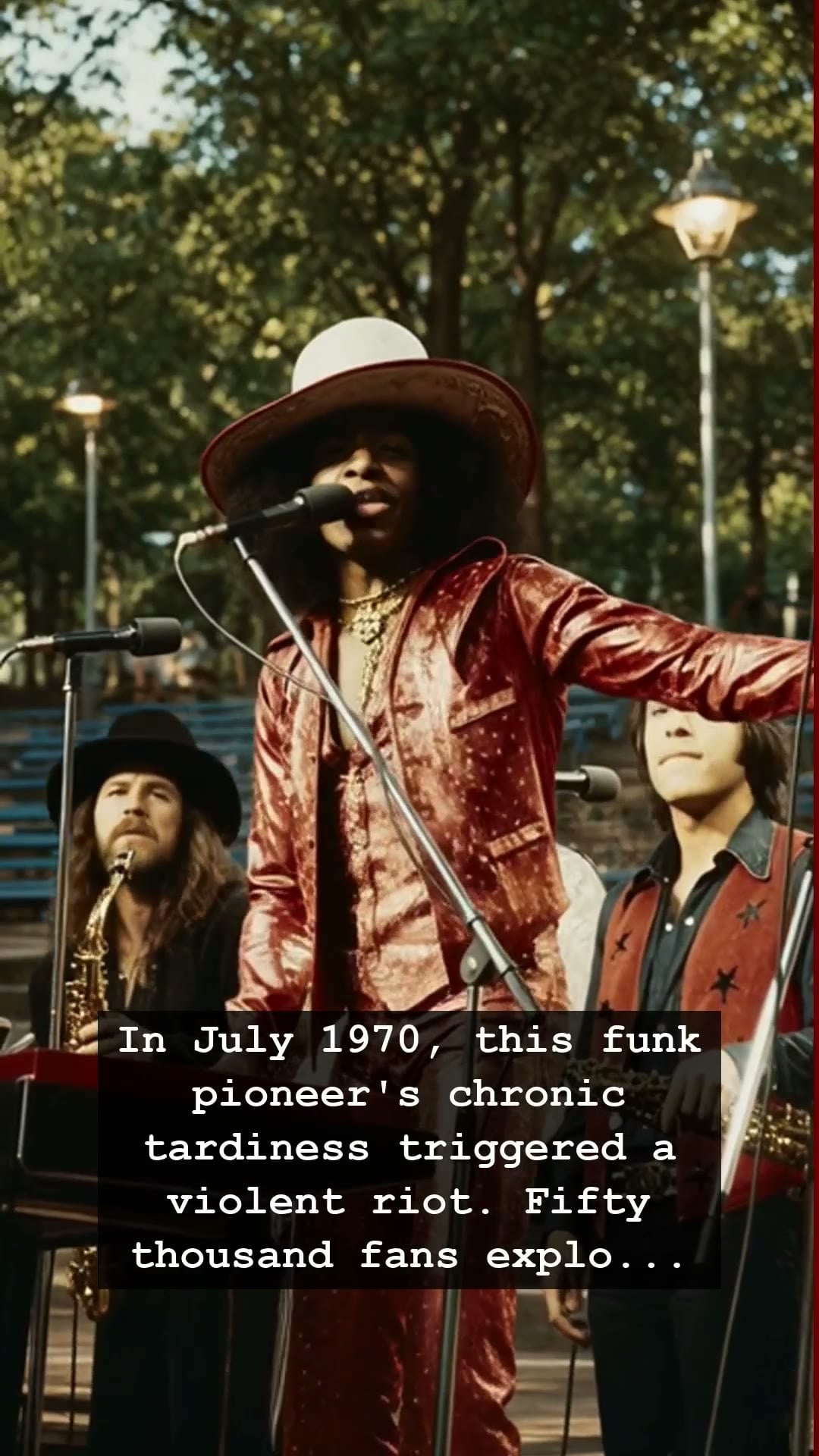
The year was 1970, a summer simmering with the thick, electric tension of a changing America. For the fifty thousand fans who descended upon Chicago’s Grant Park, the night promised a transcendental experience fueled by the revolutionary, psychedelic funk of Sly Stone and his Family Stone. By then, Sly Stone had already cemented his status as a musical deity, having electrified the Woodstock stage just one year prior. He was the architect of a sound that blended soul, rock, and social commentary into a groove that felt like the pulse of a new decade. But as the sun dipped below the Chicago skyline, the stage remained agonizingly empty. The anticipation turned into a suffocating restlessness that soon curdled into pure, unadulterated rage.
Sly Stone was notoriously plagued by his own gravitational pull toward chaos, and his chronic tardiness had become a tragic trademark of his fame. As the hours ticked by, the Jukebox-loving youth in the crowd shifted from eager expectation to boiling hostility. When it finally became clear that the funk pioneer would not be making his grand entrance, the dam broke. The energy that was meant for dancing transformed into a frantic, violent surge. Police cruisers were set aflame, smoke billowed against the moonlight, and the park, once a site of musical pilgrimage, became a landscape of broken glass and shattered expectations. Over a hundred people were injured, and the music that was supposed to unify the masses had inadvertently ignited a riot.
This dark chapter in the history of soul music speaks volumes about the heavy, often unseen burden of celebrity during the late 60s and early 70s. For Sly Stone, the pressure to maintain his status as a cultural icon was inextricably linked to a lifestyle that increasingly relied on illicit substances to numb the strain of the spotlight. The Grant Park incident was not just about a missing performer; it was a window into the fragility of the peace-and-love era. It highlighted the dangerous intersection where massive, unmanaged public demand collided with the crumbling mental health and reliability of its stars. The allure of the era was immense, but the price paid in sweat, blood, and instability was rarely mentioned on the radio.
Looking back, the story of Sly Stone remains one of the most compelling tragedies in rock and funk history. He was a visionary who could command the world with a single bass line, yet he often found himself trapped in the vortex of his own runaway success. That night in Chicago serves as a haunting reminder of the volatility inherent in an era that tried to change the world through sound alone. It is a moment that echoes through the annals of music history, forever marking the line where the dream of the sixties met the harsh, burning reality of the seventies.
Even today, whenever we put on a classic record from the Family Stone, we hear that infectious, golden groove, but we also hear the shadows behind it. The music remains timeless, but the human story behind the legend is one of triumph, excess, and the heavy weight of being an idol. Do you remember the tremors of that turbulent time, or perhaps the way the music made you feel before the world got so complicated? Let the rhythm take you back, but remember that even the brightest stars cast long, cold shadows when the music finally stops.