
The year was 1969, and the world was drunk on the promises of the Summer of Love. Young people gathered in fields across America, convinced that music could heal a fractured society. They called it the Age of Aquarius, a time when peace and love were supposedly the ultimate currency. But as the decade drew to a close, a chilling event in the desolate hills of Altamont Speedway would shatter that illusion forever. The Rolling Stones, the bad boys of rock and roll, stood at the center of a storm that proved the innocence of the sixties was not just fading—it was being violently murdered.
The Rolling Stones were arguably at the height of their powers, having curated a free concert that was meant to be the West Coast answer to Woodstock. But unlike the carefully organized peace festivals of the era, the Altamont Free Concert was a logistical nightmare from the start. Under the blistering sun, the crowd grew restless, agitated by a chaotic atmosphere where the Hells Angels had been hired as unofficial security. The air was thick with the scent of cheap beer, sweat, and a growing, palpable tension that even the most hardened roadies couldn’t ignore. The dream of unity was rapidly transforming into a volatile reality.
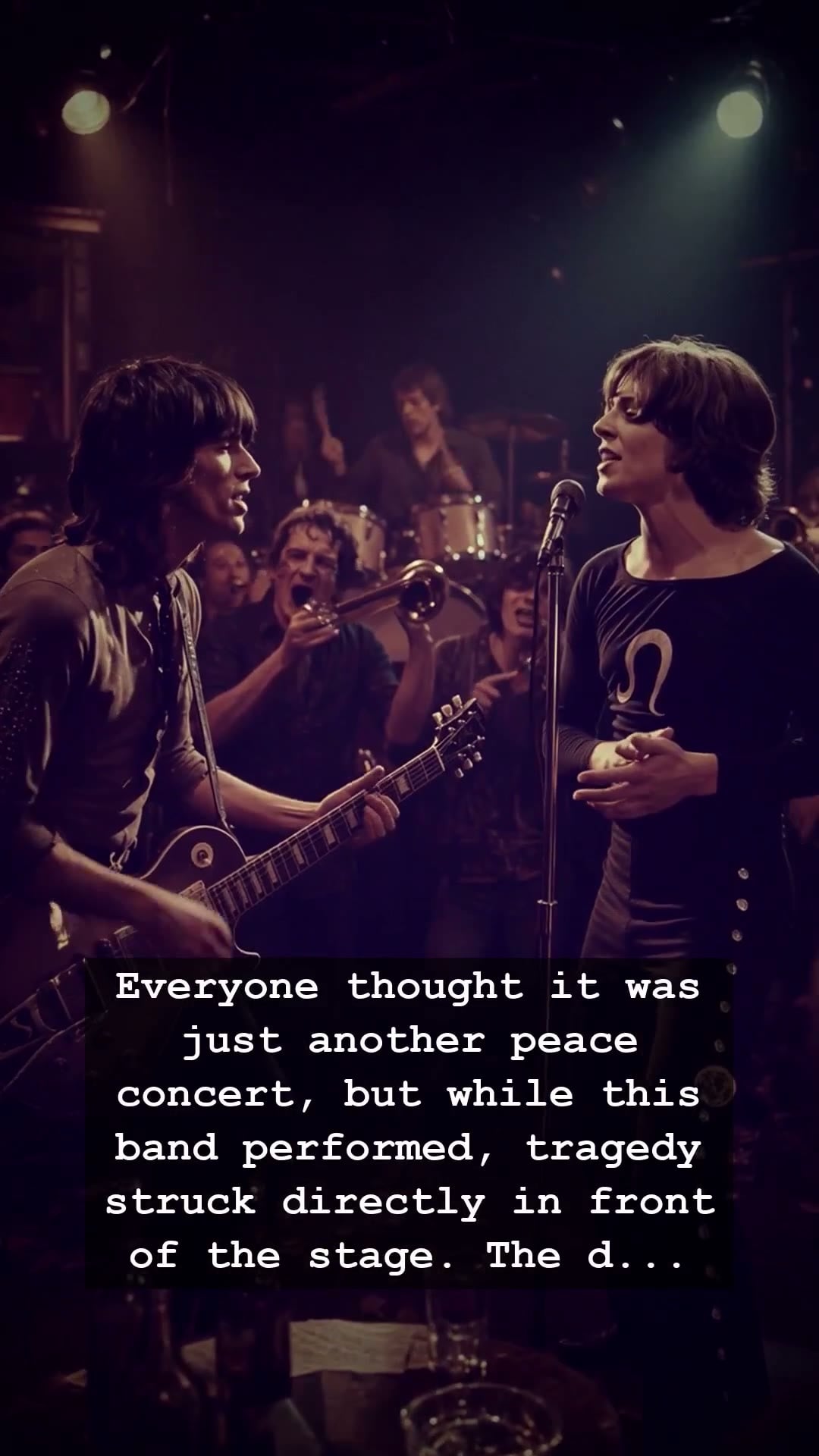
As the sun began to dip below the horizon, the energy reached a fever pitch. Mick Jagger and the rest of The Rolling Stones took to the stage, launching into the dark, rhythmic chords of Sympathy for the Devil. The irony of the moment remains one of history’s most haunting footnotes. As the band played their chilling anthem, a young man named Meredith Hunter was killed right in front of the stage. The music didn’t stop. The Rolling Stones played on, oblivious to the fact that just yards away, the naive idealism of a generation was being extinguished in a struggle that would forever mark the end of the peace-and-love era.
In the aftermath, the tragedy at Altamont became the definitive dark mirror to the light of Woodstock. For many, it was the final nail in the coffin of the counterculture. The Rolling Stones, who had embodied the rebellion of the decade, suddenly seemed to capture the nihilism that was creeping into the culture at large. It was no longer about changing the world; it was about surviving the chaos. The innocence of the sixties had been replaced by a cynical, hard-edged reality that would define the music and the mood of the seventies to come.
Today, we look back at the footage from that day with a heavy heart. The grit, the costumes, and the raw power of The Rolling Stones remain etched in our cultural consciousness, but Altamont serves as a somber reminder of how fragile those idealistic dreams truly were. It was a turning point that changed how we perceive live music forever. When the music stopped that night, the era of pure peace died with it, leaving behind a legacy of music that still echoes with the ghosts of a broken dream.