
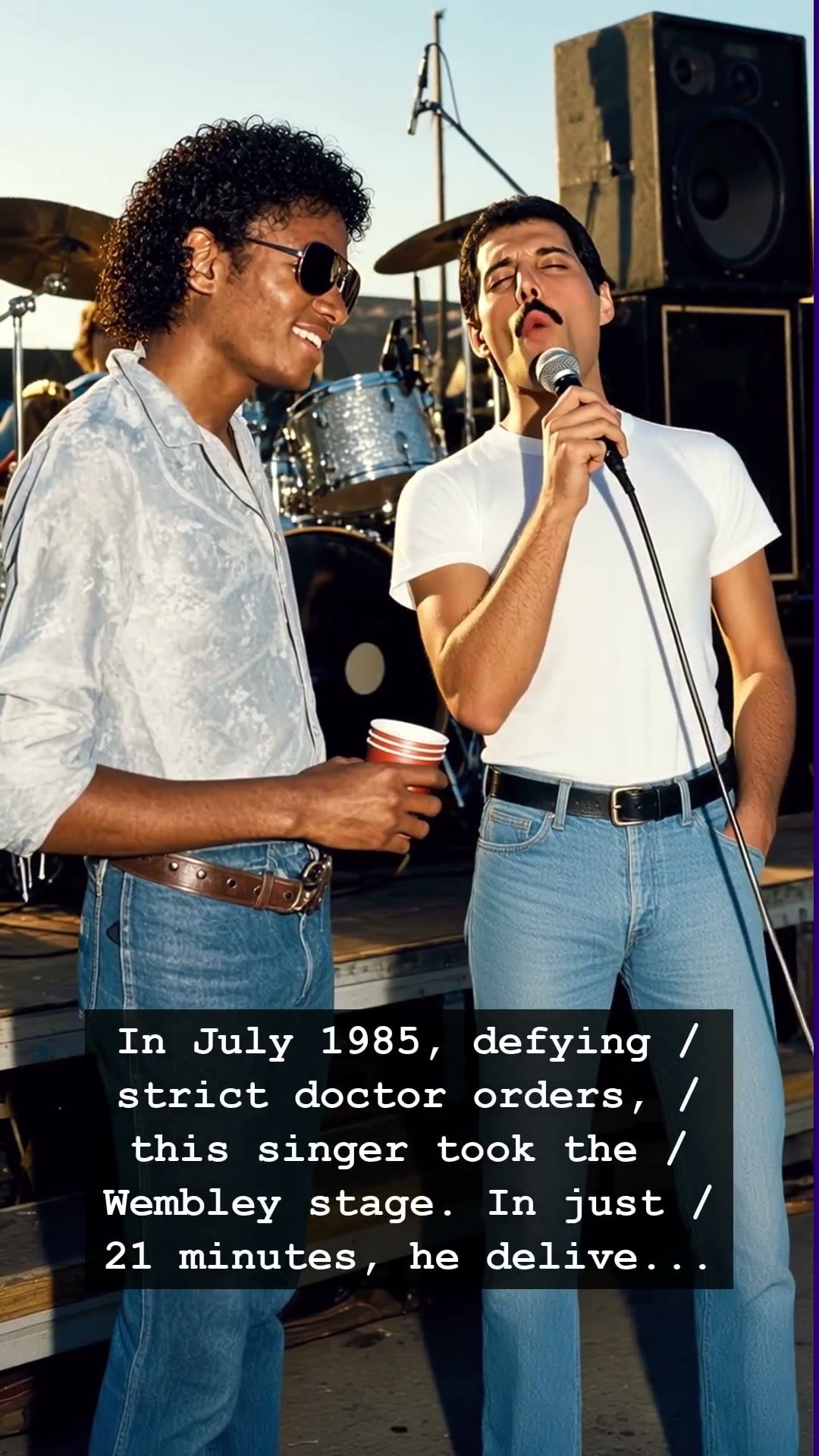
It was July 13, 1985. The atmosphere at Wembley Stadium was thick with the humidity of a sweltering summer day and the collective anticipation of 72,000 screaming fans. Backstage, the air was different. Freddie Mercury, the flamboyant frontman of Queen, stood in the shadows. He had been warned by his doctors to avoid strenuous activity, his voice strained and fragile. But as the clock struck, he didn’t retreat. He walked onto that stage not just as a performer, but as a force of nature, prepared to deliver what many historians and rock critics consider the greatest live performance in the history of rock and roll.
For those of us who grew up in the era of the Walkman and the crackle of vinyl, this moment at Live Aid remains etched in our collective memory like a sacred artifact. Queen was arguably past their stadium-rock peak by 1985, yet in those 21 minutes, Freddie Mercury redefined the genre. He commanded the massive crowd with nothing but a piano, a microphone, and an ego that transcended the physical pain he was secretly enduring. It was a masterclass in audience connection, a testament to the raw, unadulterated power of 1980s arena rock that no modern digital production could ever replicate.
What made the performance so hauntingly beautiful was the vulnerability masked by his soaring vocals. Freddie Mercury didn’t just sing the songs; he lived them. From the iconic piano chords of Bohemian Rhapsody to the stadium-thumping rhythm of We Will Rock You, he held the entire world in the palm of his hand. Even the legends watching from the wings—the biggest stars of the 80s—stood in stunned silence. There was no room for the vanity or the excess that defined the decade; there was only the pure, electric connection between a man and his music.
Behind the curtains, the reality was far more fragile. Freddie Mercury was battling personal demons and a grueling tour schedule that threatened to burn him out entirely. Yet, as the cameras broadcasted the event to nearly two billion people globally, you saw none of that. You saw a man who had transformed his trauma and his drive into a sonic monument. That day at Wembley was more than a charity concert; it was the definitive peak of a career that had spanned the birth of glam rock and the evolution of the stadium spectacular.
Decades later, we still reach for those tapes and digital archives to relive the magic. We look back at the 80s as a time of excess, but in those 21 minutes, Freddie Mercury proved that rock was about the soul. He pushed past his limits, ignored the warnings of his physicians, and cemented his status as a god among men. When the final note of We Are the Champions faded into the London sky, he hadn’t just played a set; he had etched himself into the bedrock of human history. Tell us, do you remember exactly where you were when those opening chords hit?