
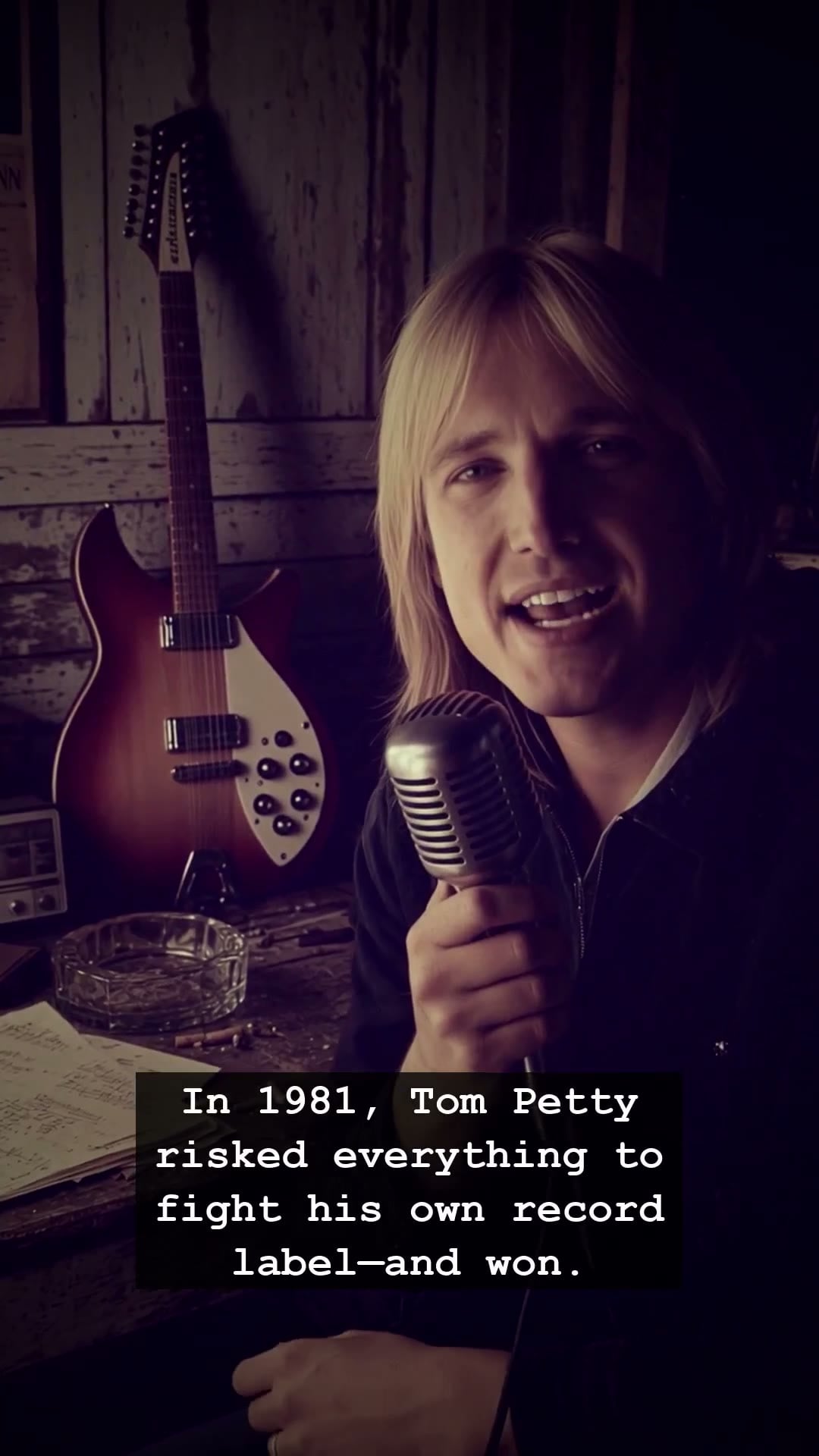
In the golden age of the jukebox and the analog charm of the early 80s, the music industry was a kingdom ruled by iron-fisted record labels. Artists were often treated like disposable cogs in a massive corporate machine, expected to churn out hits while executives pocketed the lion’s share. But in 1981, one man decided he had finally had enough. Tom Petty, a rock and roll purist with a voice that defined the American heartland, stood at a precarious crossroads. He wasn’t just fighting for a royalty check; he was fighting for the soul of his creative integrity against MCA Records, an industry giant that dared to hike the price of his upcoming album, Hard Promises, to a premium level without his consent.
Most musicians would have quietly accepted their fate, fearful of being blacklisted from the airwaves of FM radio. But Tom Petty was cut from a different cloth. He saw the proposed price hike not just as a business decision, but as a betrayal of his fanbase. He knew that the very people saving up their allowance to buy his records at the local shop shouldn’t be exploited by greedy corporate suits. So, he took the most drastic step imaginable: he threatened to withhold the album entirely, effectively launching a high-stakes standoff that held the entire industry in suspense. It was a move of pure, unadulterated defiance that felt like something out of a Hollywood script.
The tension was palpable. As the battle intensified, Tom Petty used the power of the burgeoning media landscape to rally his listeners. He didn’t just hide in his studio; he spoke out, making it clear that he was willing to let his career burn to the ground rather than compromise his principles. It was a moment of profound vulnerability and courage, one that echoes through history as a turning point for artist rights. The labels had no idea they were dealing with a man who valued his creative output more than the safety of his contract. He was a force of nature, protecting the sanctity of rock music with a fierce, quiet intensity.
Ultimately, the record label blinked first. The release of Hard Promises proceeded at a standard price, and Tom Petty emerged not just as a rock star, but as a hero for his fellow musicians. It set a precedent that allowed artists to challenge the status quo, proving that the bond between a songwriter and their audience was stronger than any corporate mandate. This victory cemented his status as a legendary figure, the kind of person who stood tall when the lights were brightest and the pressure was at its peak.
Today, when we look back at the era of the Walkman and the shift toward mass-market commercialism, the story of Tom Petty serves as a vital reminder of the cost of fame. It wasn’t just about the chart-topping singles; it was about the integrity behind the melody. His rebellion remains a timeless lesson for every generation that music, at its core, is a personal covenant that should never be sacrificed for profit. We still spin his records today, not just for the sound, but for the spirit of the man who risked everything to keep his promise to us.