
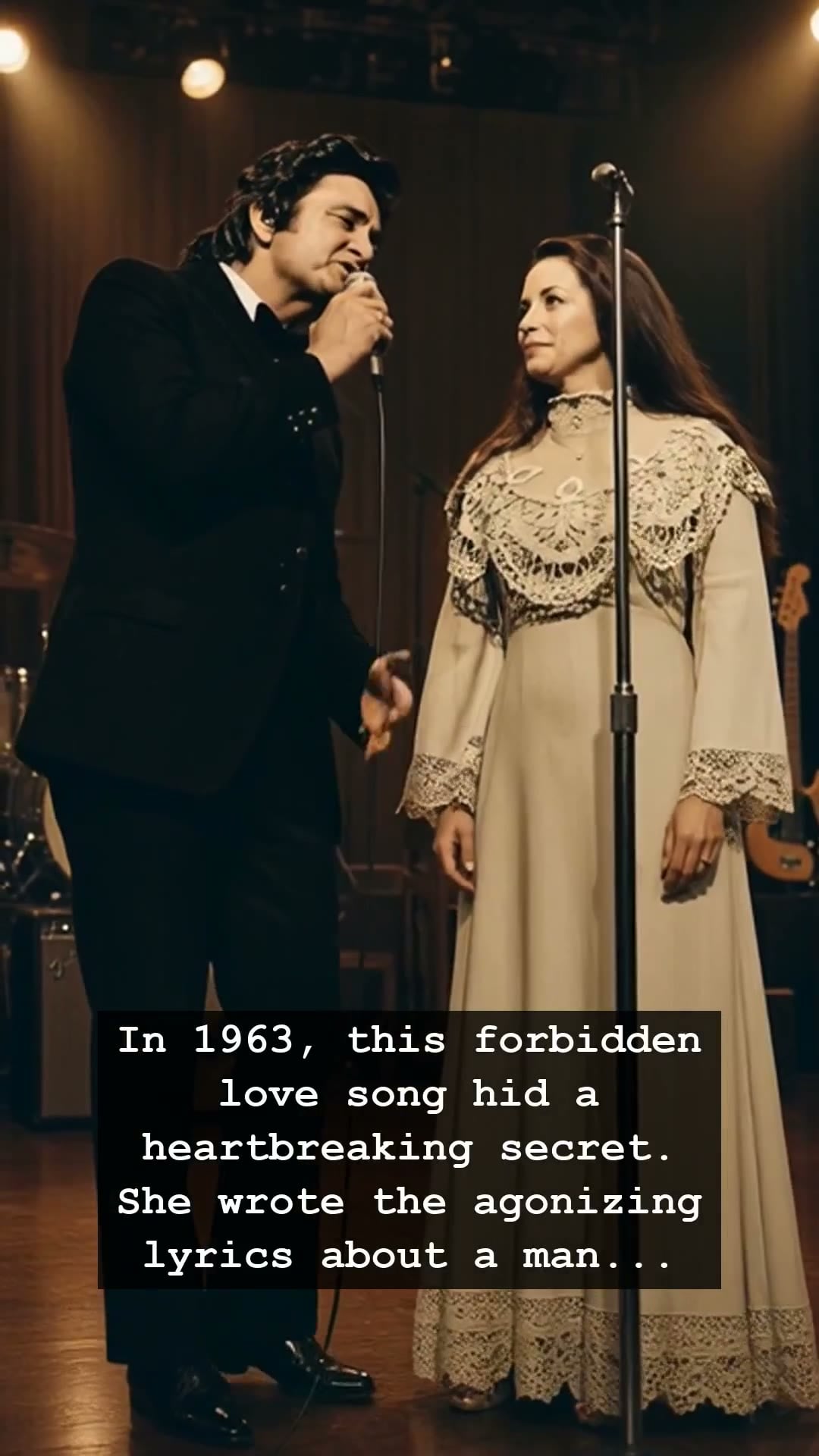
In 1963, a haunting melody swept across the American airwaves, crackling from jukeboxes in diners and echoing through the static of transistor radios. That song was Ring of Fire, a track that would become one of the most iconic anthems in the history of country music. Yet, beneath the fiery brass arrangements and the rhythmic stomp of the beat, lay a secret that was never meant for the public ear. It was not merely a song about love; it was a desperate confession penned by June Carter, a woman wrestling with a forbidden passion for a man she was strictly forbidden to touch: Johnny Cash.
At the time, the world knew Johnny Cash as the Man in Black, a rising star with a dark edge, struggling under the weight of his own demons and a crumbling marriage. June Carter, the spunky, radiant songstress of the legendary Carter Family, found herself trapped in a crucible of her own making. As they toured together, the chemistry between them was electric and undeniably dangerous. June watched from the wings, observing Johnny’s slow descent into the abyss of addiction and chaos, feeling her own heart fracture with every beat of his self-destructive rhythm. The lyrics she scrawled onto paper were her own private map through the burning, agonizing wilderness of her emotions.
She wrote of love as a searing, inescapable trap, a fire that consumed everything it touched. It is easy to look back at their later years and see the romance, but in 1963, the reality was a tangled mess of moral conflict and professional turmoil. June was essentially writing an obituary for her own peace of mind. She was terrified of what a relationship with Johnny would mean for her career, her reputation, and her soul. She captured the feeling of drowning while simultaneously burning, a dichotomy that resonated deeply with the restless, post-war American youth who were beginning to question the rigid societal norms of their parents’ generation.
When Johnny Cash finally heard the lyrics and decided to record the song, he did so with an intensity that transformed June’s quiet agony into a roaring, soul-stirring masterpiece. The addition of the mariachi-style horns provided a dramatic flair that felt almost apocalyptic, perfectly mirroring the volatile state of his life at the time. It was a pivotal moment in music history, a bridge between the traditional country sound and the raw, unvarnished emotional honesty that would later define the soul and folk-rock movements of the era.
Today, decades after the golden age of vinyl and the flickering lights of the early television era, the song remains a testament to the power of unrequited, perilous love. It serves as a reminder that the greatest art often emerges from our most private sufferings. Even now, when the familiar opening brass hits our ears, we are transported back to that smoke-filled era where passions were kept under lock and key. The story of Johnny Cash and June Carter reminds us that even the deepest, most forbidden fires can eventually light the way home.