
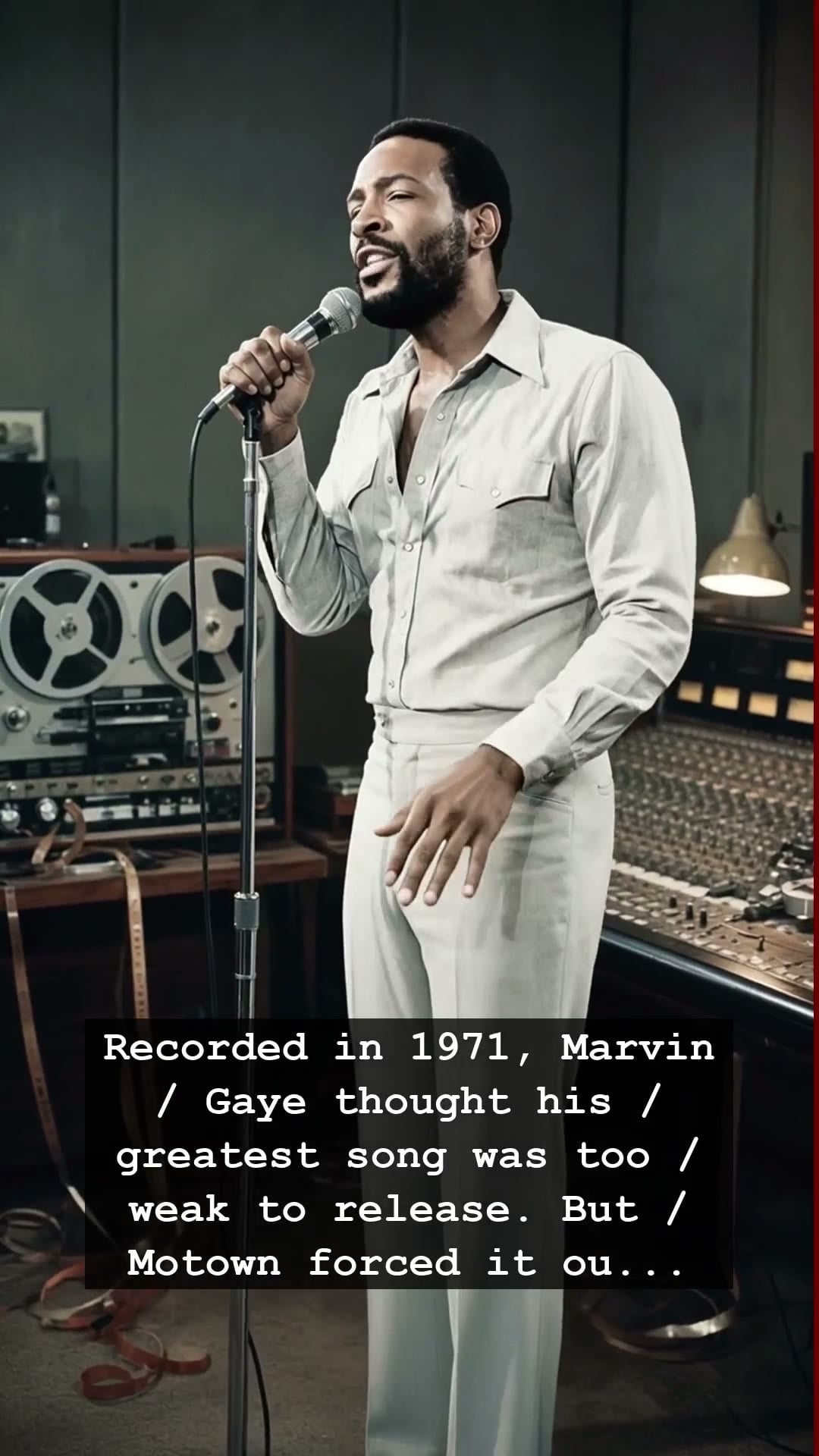
Imagine a world where What’s Going On never graced the turntable of a jukebox or drifted through the speakers of a classic 1971 Mustang. It is hard to fathom, yet in the hazy, smoke-filled air of a Motown recording studio, the man behind the music almost chose silence. Marvin Gaye, the Prince of Soul, sat amidst the tension of a changing America, convinced that his most profound work was simply too weak, too fragile, and too politically risky to be released to the public. He stood on the edge of a nervous breakdown, haunted by the pressure of his own genius and the stifling expectations of the industry.
At the dawn of the 1970s, Marvin Gaye was transitioning away from the polished, hit-making machine of Berry Gordy’s Motown. He was tired of singing love songs while the world outside his window burned with civil unrest and the shadows of the Vietnam War. When he finally laid down the tracks for what would become a seminal soul masterpiece, he was searching for something deeper—a cry for humanity. Yet, to the ears of the label executives who were used to upbeat radio anthems, his new direction sounded like a career-ending mistake. They dismissed his vision as a deviation from his proven success.
The drama behind the scenes was palpable. Motown viewed the record as a potential disaster, refusing to promote it or see its commercial value. Marvin Gaye, already battling his own demons and the crushing weight of fame, nearly walked away from the project entirely. He saw the music as a spiritual reflection of his internal turmoil, but the suits saw only a commercial risk. It is one of history’s great ironies that the very track Marvin Gaye feared was too weak to stand on its own feet would eventually be hailed as one of the greatest compositions in the history of music.
When the label finally forced it out—perhaps more out of a sense of obligation than actual belief—the cultural landscape of America shifted instantly. The song became a bridge between generations, capturing the disillusionment of the post-Woodstock era while maintaining a soulfulness that defined the Motown sound. It proved that Marvin Gaye was not just a pop star; he was a visionary capable of turning his deepest anxieties into a universal language of empathy. It resonated in the backstreets of Detroit and reached the quiet living rooms of suburbia, transcending the boundaries of radio airplay.
Today, we look back at 1971 as a pivotal turning point in musical history. The legacy of Marvin Gaye reminds us that the most significant art often comes from a place of vulnerability and defiance. We still hear the echoes of his struggle every time we drop the needle on a vinyl record. As the music fades into that timeless, velvet melody, we are reminded that greatness rarely follows the rules; it only requires the courage to be heard.