
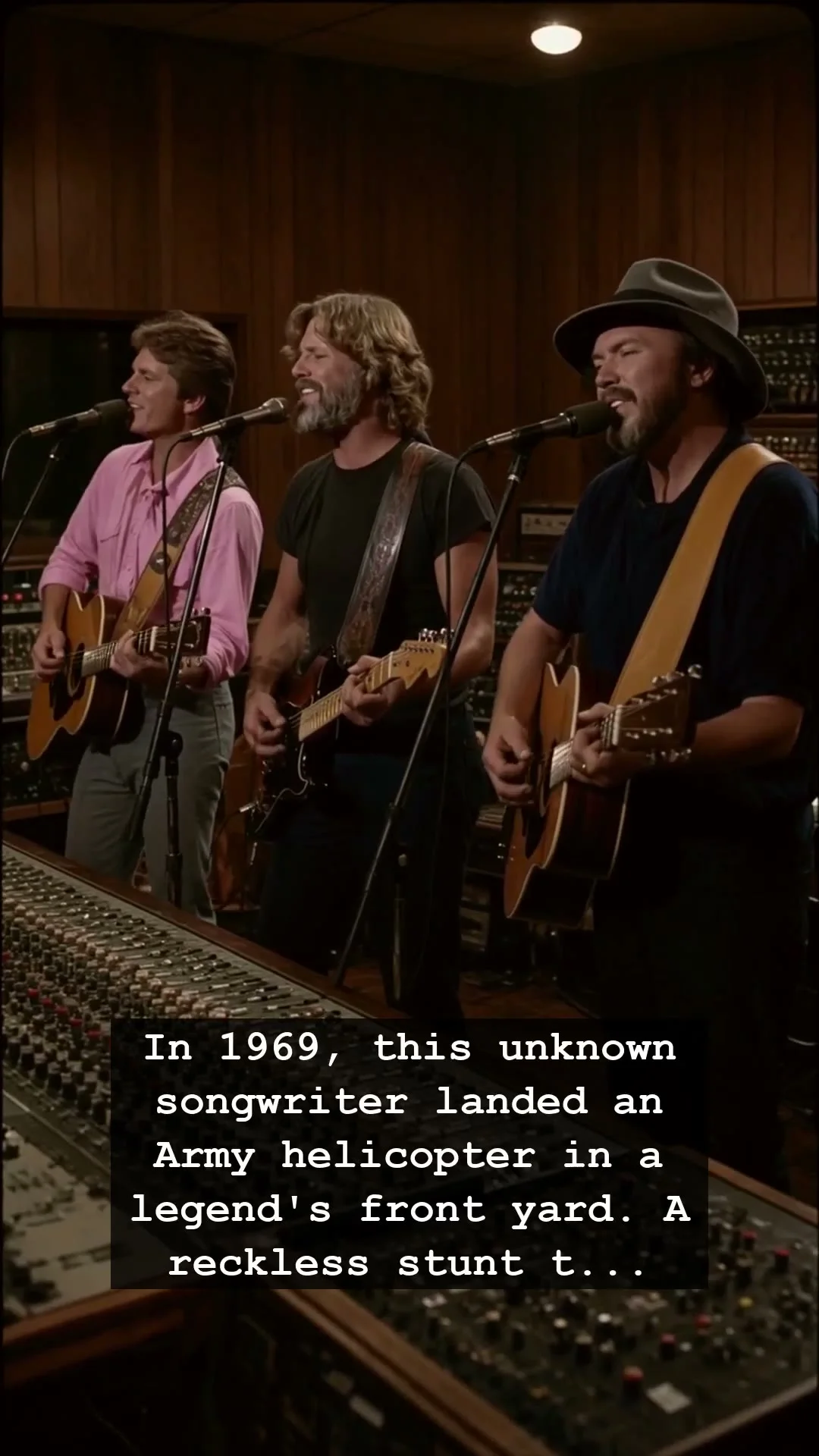
It was 1969, and the air over Hendersonville, Tennessee, hummed with the sound of rotors cutting through a humid afternoon. To the neighbors, it looked like a military emergency, but for the man watching from his porch, it was an intrusion that defied all logic. An unknown songwriter named Kris Kristofferson had just landed an Army helicopter directly onto the front lawn of Johnny Cash. It was a reckless, desperate, and utterly audacious stunt—a gamble that could have ended his career before it began. Yet, this wasn’t an act of madness; it was a desperate plea for recognition from a man who knew his songs were destined for greatness.
Kris Kristofferson was not your typical struggling artist. A former Rhodes Scholar and an Army captain, he had turned his back on a comfortable military future to scrape by in Nashville, emptying ashtrays and working on offshore oil rigs. The world of country music was a guarded fortress back then, and Kris Kristofferson felt like an outsider knocking on a heavy iron door. By dropping onto the Man in Black’s lawn, he forced a legend to pay attention. Johnny Cash, ever the admirer of a good outlaw spirit, didn’t call the police. Instead, he invited the pilot inside. In that moment, the trajectory of American songwriting shifted forever.
This incident captures the raw, unvarnished intensity of an era where music was born from grit rather than algorithms. While the Jukeboxes of the day were spinning tales of heartbreak and dusty roads, Kris Kristofferson was bringing a new, poetic sensibility to the genre. He wasn’t just writing songs; he was documenting the human condition with a cynical yet deeply empathetic eye. Through this legendary meeting, he eventually handed Cash a demo of Sunday Mornin’ Comin’ Down, a song that would become a defining anthem for the weary and the lost.
The music scene of the late 1960s was a volatile landscape, oscillating between the structured hits of the past and the burgeoning rebellion of the folk-rock movement. Kris Kristofferson arrived as the ultimate bridge between these worlds. His lyrics carried the weight of his own experiences—the isolation of the barracks, the exhaustion of the oil fields, and the crushing weight of artistic ambition. He represented the bridge between the polished Nashville sound and the emerging grit that would soon define the Outlaw Country movement, influencing a generation of musicians who valued truth over radio-friendly perfection.
Today, the story of that helicopter landing remains one of the most cherished pieces of music folklore. It serves as a reminder that the path to immortality is rarely a straight line. It is paved with audacity, a bit of recklessness, and the unwavering belief that your voice deserves to be heard. Kris Kristofferson didn’t just land a machine on a lawn; he landed himself in the history books, proving that sometimes, you have to break the rules to change the game. As we look back at the echoes of that decade, we are reminded that true legends are built on moments of absolute, defiant courage.