
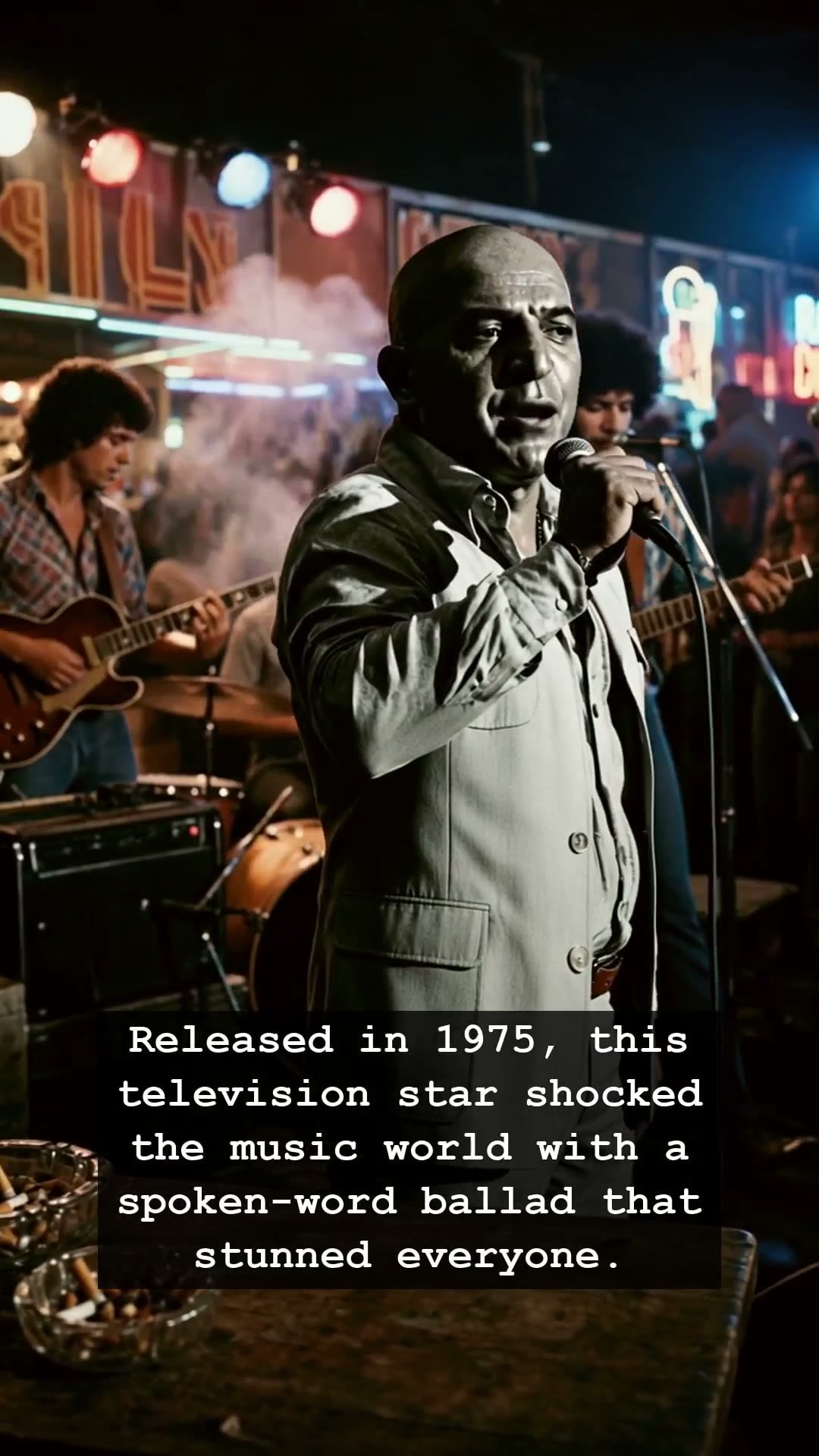
It was 1975, the era of the Walkman’s infancy and the golden age of the jukebox, when the world of music was suddenly turned on its head. While the airwaves were dominated by the rising glitter of disco and the polished production of arena rock, a television icon did the unthinkable. Telly Savalas, the tough-talking, lollipop-sucking star of the hit crime drama Kojak, stepped into a recording booth and delivered a performance that defied every convention of the pop industry. He didn’t sing in the traditional sense; he whispered, he narrated, and he commanded the microphone with a gravelly, soulful gravitas that left critics dumbfounded and listeners utterly mesmerized by his spoken-word rendition of If.
When Telly Savalas first released this track, the reaction from the music establishment was swift and merciless. Many laughed at the audacity of a rugged television detective attempting to break into the hit parade. Who did he think he was, moving from the mean streets of New York City television sets to the hallowed halls of professional recording studios? Yet, the public disagreed with the skeptics. There was something undeniably magnetic about his delivery. In an era often defined by high-octane performances, the intimacy of his voice felt like a confession. It resonated with the lonely, the hopeful, and the heartbroken across the United Kingdom and beyond.
To the shock of every major label executive, the song climbed the ladder of success with relentless momentum, eventually securing the number one spot on the UK Singles Chart. It was a cultural anomaly, a moment in time where personality and charisma outweighed the standard requirements of pop stardom. Telly Savalas proved that authenticity—even if it came in the form of a dramatic, spoken-word monologue—could pierce through the noise of the 1970s. For those who spent their nights at Studio 54 or listening to the radio with the lights dimmed, his voice became a strange, unexpected comfort.
Looking back at that period, the success of Telly Savalas serves as a reminder of a time when the music charts were still capable of producing delightful, surreal surprises. The boundaries between television, film, and the music industry were porous, allowing for crossovers that feel impossible in today’s hyper-curated digital landscape. His performance captured the essence of mid-seventies pop culture, a period where glamour and grit lived side-by-side. Behind the polished facade of the television star was a man who possessed a deep, resonant emotional intelligence that translated perfectly to vinyl.
Even today, nearly half a century later, the track holds a curious place in the pantheon of seventies music. It stands as a testament to the fact that sometimes the most unlikely artists create the most enduring legacies. Whenever that familiar melody begins to play, one is instantly transported back to a time of shag carpets, rotary phones, and the genuine shock of hearing a detective turn into a chart-topping crooner. Do you remember where you were when you first heard him tell his story? It remains one of the most charming, nostalgic footnotes in the history of popular music.