
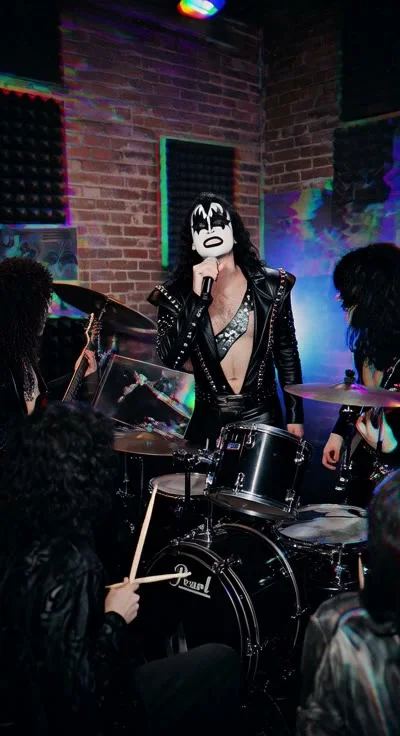
In the golden age of arena rock, where stadium lights blinded the masses and pyrotechnics defined the sound of a generation, one man stood behind the kit as a symbol of mystery and hidden agony. In 1980, the legendary band KISS was at a crossroads, having lost their original drummer and their cultural momentum. Out of the shadows stepped Eric Carr, a man who donned the Fox makeup and unknowingly began a decade-long journey that would solidify him as the band’s most reliable and beloved heartbeat. Yet, behind the fierce, rhythmic power that shook the rafters of massive arenas, Eric Carr was nursing a silent, heart-wrenching battle that few outside his inner circle truly understood.
To the fans of the early eighties, Eric Carr was the new blood that saved the machine. He brought a heavy, propulsive energy that revitalized the band’s sound just as the MTV era was beginning to reshape the music industry. He was not just a replacement; he was the engine that powered the transition from the glitz of the seventies to the harder, sharper edges of heavy metal. Throughout the decade, as the band ditched the masks and later returned to their iconic personas, Eric Carr remained the constant. He was the gentle soul in a band known for its brash, larger-than-life ego, a man who spent his hours on the road in the confined space of a hotel room, often pining for the normalcy that his meteoric rise to fame had stripped away.
The tragedy of Eric Carr lies not just in the premature end of his life, but in the quiet dignity with which he carried his personal burdens. While the rock and roll lifestyle of the eighties often demanded excess and reckless abandon, Eric Carr was the professional who never missed a beat, even when his health began to betray him. He lived through the peak of the arena rock era, watching the rise of hair metal and the shifting sands of musical trends, all while dealing with a secret diagnosis that would eventually claim his life at the young age of forty-one. His death in 1991, the same day as Freddie Mercury, meant his story was often eclipsed by a global tragedy, yet for the die-hard KISS army, he remains the heart of the band.
Looking back, there is a profound melancholy in watching old footage of the band. When we see Eric Carr behind the drum kit, we see a man who gave everything to the music, playing with a passion that suggested he knew his time on the stage was precious. He wasn’t just a drummer; he was the personification of the eighties rock dream—full of grit, talent, and an unmistakable vulnerability that resonated deep within the chest of every fan in the nosebleed seats. His story is a poignant reminder of the fragility behind the mask, a testament to a man who lived to perform and died a legend, leaving behind a legacy that still echoes in the halls of rock history. May the rhythm of the Fox never fade from our memories.