
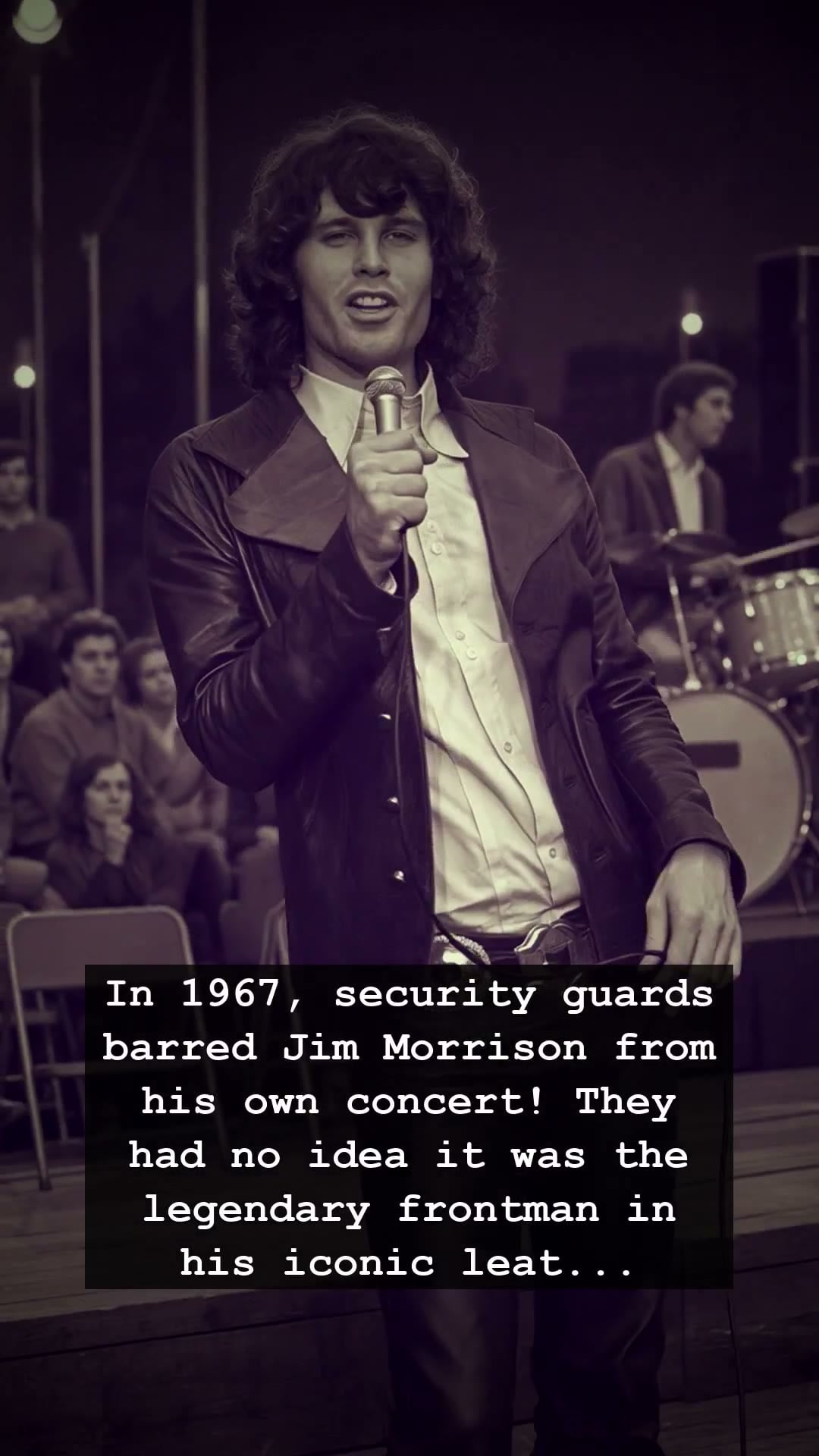
It was 1967, the year the Summer of Love bloomed and the airwaves crackled with the psychedelic electricity of a changing world. At a venue in Connecticut, the line for a Doors concert stretched around the block, a sea of fringed jackets and wide-eyed youth eager to witness the shaman of rock and roll. Inside, the energy was thick, bordering on volatile. Outside, standing near the stage entrance, was a man in iconic leather trousers, looking perhaps a bit more disheveled than the polished stars of the era. He tried to walk through the heavy metal doors, only to be met with the unyielding arms of a security guard who had no idea he was face-to-face with the man the crowd was screaming for. Jim Morrison, the magnetic, unpredictable, and legendary frontman of The Doors, was barred from his own show.
To the security guards of the mid-sixties, rock stars were expected to look a certain way—groomed, compliant, and clearly identifiable. Jim Morrison, with his wild, tangled curls and gaze that seemed to look right through the fabric of reality, defied those expectations. He was not just a singer; he was a poet of the abyss, a man who lived as if every night were his last on this earth. The irony of the moment is as sharp as it is poetic. Here was a man who challenged every societal boundary, being physically blocked by the very institutions he sought to dismantle with his dark, hypnotic lyrics and theatrical stage presence. It is a snapshot of the disconnect between the establishment and the raw, uncontained spirit of the 1960s.
This incident serves as a perfect microcosm of the life of Jim Morrison. Throughout his brief, blazing career, he existed on the fringes, constantly testing the limits of what a rock performer could be. From the hazy, smoke-filled clubs of the Sunset Strip to the massive arena tours that would follow, Morrison was always an outsider looking in, even while leading the charge. He brought an intensity to music that felt dangerous, a stark contrast to the bubblegum pop that still held sway in some corners of the industry. His presence was not just a performance; it was a confrontation, and that is why his legend remains so fiercely protected by fans today.
The Doors were not merely a band; they were the soundtrack to the cultural awakening of an entire generation. Whether it was the pulsating rhythm of Light My Fire or the ominous, cinematic crawl of The End, Morrison anchored the music in a darkness that felt strangely comforting to those lost in the search for something deeper. Looking back, we realize that the man being turned away at the door that night was the same man who would go on to define the psyche of an era. The guards let him in eventually, but the world was never quite able to contain him for long.
Even decades later, stories like this remind us of the raw, unscripted nature of the golden age of rock. We miss the unpredictability of a time before digital perfection, when the line between the audience and the idol was blurred, and when a legend could be mistaken for a stranger in the shadows. Jim Morrison remains a lingering ghost in the hallways of music history, a reminder that the best stories are the ones that happen when the cameras are turned away. Do you have a favorite memory of the Doors that still burns bright in your mind today?