
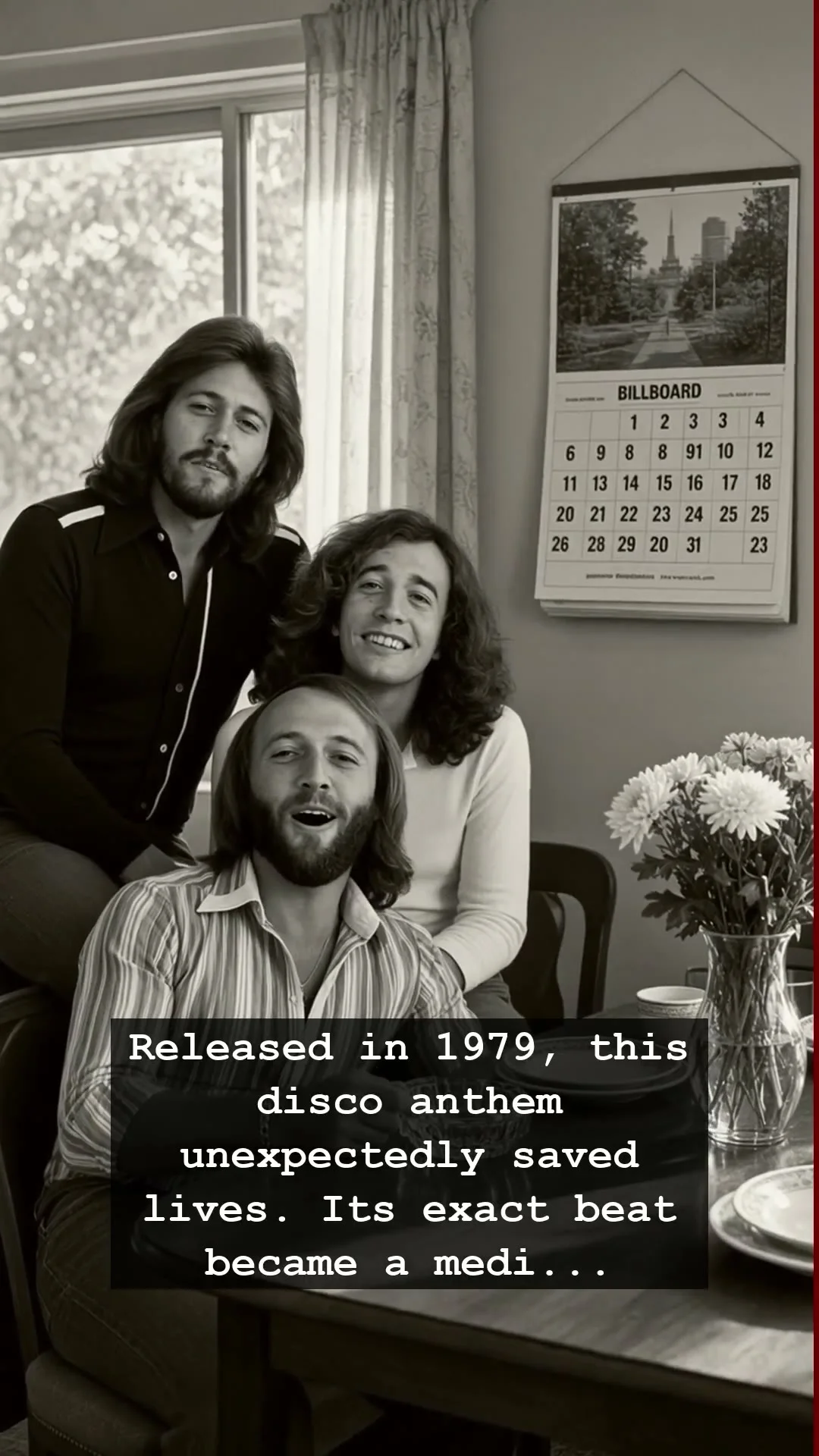
It was 1979, a year when the world was spinning under the shimmer of mirror balls and the pulsating basslines of Studio 54. The Bee Gees, once seen as modest pop balladeers, had ascended to the throne of global superstardom, draped in white suits and coated in the velvet sheen of the disco era. But amidst the hedonism and the glitter, one track, Stayin’ Alive, was destined for a purpose far more profound than just dominating the Billboard charts or filling dance floors. Decades later, this song would transcend its status as a pop anthem to become an unlikely guardian of human life, quite literally teaching millions how to save one another.
In the high-pressure environment of emergency medicine, the rhythm of chest compressions during CPR is a matter of strict scientific precision. Medical experts realized that the chest needs to be pressed at a rate of 100 to 120 beats per minute, a pace that happens to align perfectly with the relentless, driving tempo of Stayin’ Alive. When the Bee Gees recorded those iconic opening chords, they were chasing the heartbeat of a generation, not realizing they were syncing up with the heartbeat of humanity itself. Today, in medical training centers across the globe, the song acts as an audible metronome, ensuring that the rhythm of life remains unbroken during moments of crisis.
This transformation from a dancefloor filler to a medical mnemonic highlights the duality of the Bee Gees’ legacy. Barry, Robin, and Maurice Gibb were masters of melody, but their journey was far from the simple, polished image often associated with disco. Behind the scenes, the brothers navigated intense creative rivalries, the crushing weight of sudden fame, and the fickle nature of a music industry that eventually turned its back on disco in a violent cultural backlash. Despite the disco demolition events and the unfair branding that followed, their songwriting brilliance proved resilient.
There is something deeply poetic about a song written during the height of the polyester revolution becoming a literal lifeline in hospitals. The Bee Gees captured the spirit of survival in their lyrics, writing about walking the streets and staying alive against the odds. Little did they know, their rhythmic precision would eventually provide the literal means for victims of cardiac arrest to do just that. It is a testament to the enduring power of music, proving that a song can hold more depth, utility, and legacy than its creators ever dared to imagine.
As we look back at the era of the Walkman and the jukebox, we are often chasing the ghosts of a simpler time. Yet, the Bee Gees remain firmly anchored in our modern existence, not just as icons of a nostalgic past, but as essential companions in the present. Whether you are dancing to the radio or learning a life-saving skill, the pulse of their music continues to beat on, timeless and vital. The next time you hear that familiar opening beat, remember that you are listening to more than just a melody; you are hearing the rhythm of survival.