
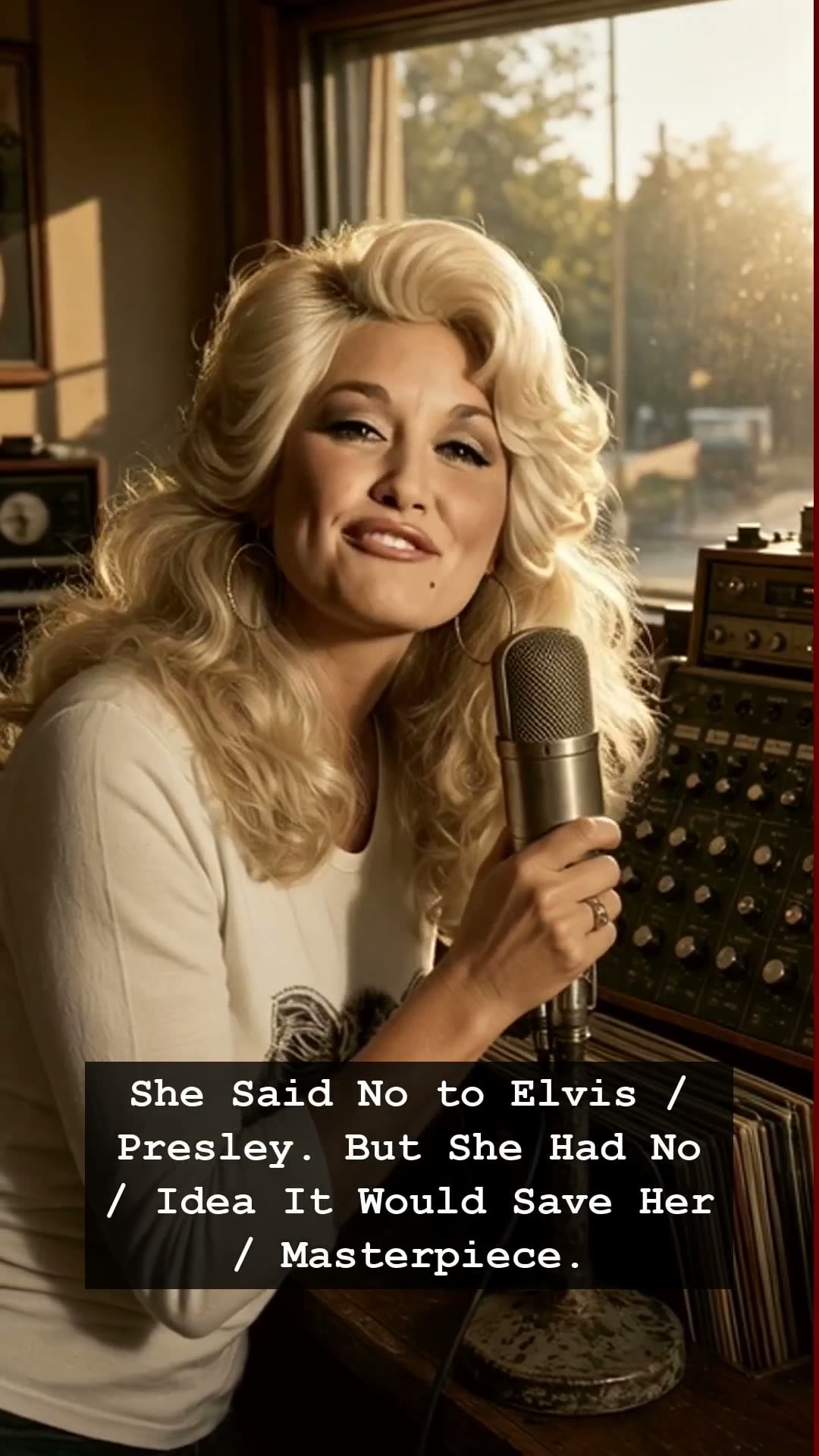
The year was 1974, a time when the jukebox was the heartbeat of every roadside diner and the golden era of country music was shifting toward a global stage. Dolly Parton, already a rising force in Nashville, found herself at a crossroads that would define her entire career. Elvis Presley, the undisputed King of Rock and Roll, had expressed a burning desire to record her latest masterpiece, I Will Always Love You. It was an offer that most songwriters would have accepted in a heartbeat, a golden ticket to mainstream immortality. Yet, sitting in a dim office with the heavy scent of cigarette smoke and the crushing weight of industry expectations, a young Dolly Parton made a decision that felt like a death sentence to her ambition.
Colonel Tom Parker, Elvis Presley’s notoriously iron-fisted manager, presented Dolly with a demand that felt like a cold blade to the heart. He insisted that she sign over half of the publishing rights to the song if the King were to record it. For Dolly Parton, this was not merely a business negotiation; it was a matter of principle and a fight for the legacy of her own creative soul. She later recounted how she spent the entire night pacing her home in tears, the silhouette of her doubt cast against the wall. She knew the power of Elvis Presley could take her song to the moon, but she refused to sacrifice her ownership to get there. The next morning, she stood her ground and told the King no.
This act of defiance was monumental. At the time, Nashville was a playground for powerful men, and turning down Elvis Presley was considered professional suicide. Yet, in that moment of vulnerability, Dolly Parton protected her masterpiece. She chose to trust her own voice, shielding the song from the corporate machinery that often chewed up artists and spat them out. Looking back, we can see this not as a missed opportunity, but as the moment Dolly Parton truly became the architect of her own legend. She wasn’t just a singer; she was a businesswoman who understood that her art was the only true currency she owned.
Years later, when Whitney Houston took that same song to stratospheric heights, the wisdom of Dolly Parton’s decision became undeniable. By keeping the rights, she secured a legacy that spanned generations, far beyond the initial fame that an Elvis recording might have provided. It is a haunting thought to imagine how differently the song’s history would have unfolded had she surrendered to the pressure. The world of 1970s music was built on these fragile bargains, and most were consumed by the greed of the era. Dolly stood apart, proving that integrity can sometimes be the most profitable path of all.
Today, when we hear the opening notes of I Will Always Love You, we are not just hearing a song; we are hearing the echo of a woman who stood her ground against a titan. It serves as a reminder of the raw, human dramas that fueled the music industry long before the digital age sanitized our memories. Whether you discovered it through the soulful belts of the nineties or the gentle, aching twang of the seventies, the story remains the same: a testament to courage. It is a beautiful irony that in saying no to the King, Dolly Parton preserved a piece of music that would eventually belong to the entire world. Do you remember where you were the first time those lyrics touched your heart?