
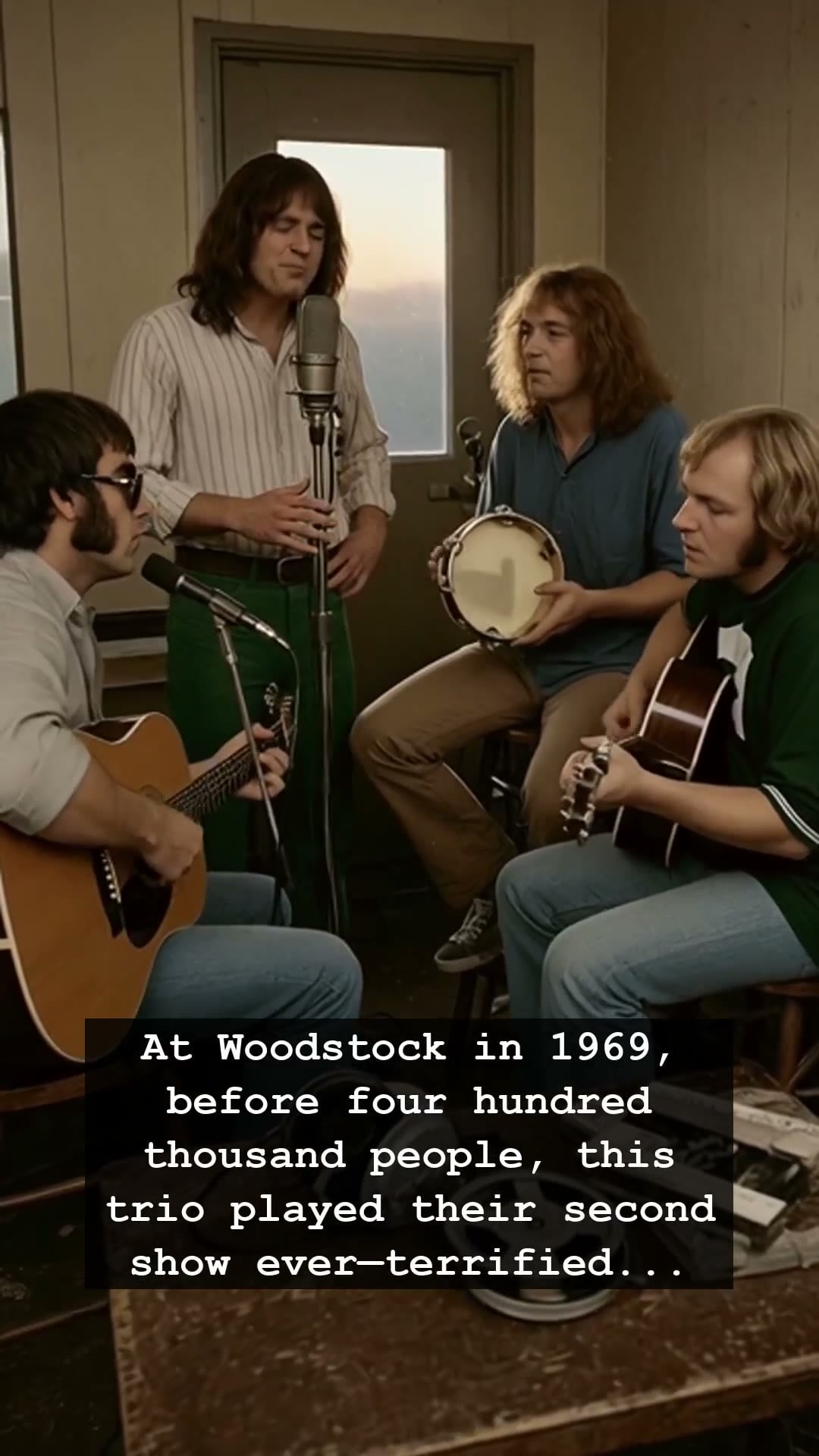
The year was 1969. The world felt like it was shifting on its axis, a cultural earthquake centered in the muddy fields of Bethel, New York. As four hundred thousand souls huddled together at Woodstock, the air thick with the scent of wet grass and radical change, three men stepped onto the massive stage. They were Crosby, Stills and Nash. They were folk royalty in the making, yet as they stood before that vast, surging sea of humanity, they were not the confident icons we know today. In truth, they were terrified. This was only their second live performance as a trio, and the sheer weight of the moment threatened to swallow them whole.
Stephen Stills later admitted the visceral fear of that night. With shaky hands and voices that had to cut through the hum of anticipation, Crosby, Stills and Nash began to play. They didn’t have the roar of an electric arena rock band to hide behind; they relied on their intricate, haunting vocal harmonies—a fragile masterpiece delivered in the middle of a psychedelic storm. It was a moment of stark vulnerability that defined the late sixties. While the era is often remembered for wild excess and loud guitars, the beauty of this performance lay in its human fragility, a sharp contrast to the chaotic backdrop of the Vietnam War era and the restless spirit of a generation searching for meaning.
What makes the story of Crosby, Stills and Nash so compelling is the friction inherent in their chemistry. David Crosby, the mercurial hippie soul; Stephen Stills, the driven perfectionist; and Graham Nash, the melodic glue holding the chaos together. They were a collision of egos and musical brilliance, an archetype of the classic rock band that would eventually unravel under the crushing weight of fame and internal discord. Yet, in that brief window at Woodstock, their personal drama was silenced by the necessity of the performance. They were simply three men trying to find the right note in a world that had seemingly lost its rhythm.
Looking back, the legacy of Crosby, Stills and Nash is tied inextricably to the symbols of their time—the dusty vinyl records spinning on Jukeboxes, the iconic poster of a dove on a guitar, and the feeling of endless possibility that defined the Woodstock generation. Their music captures a specific frequency of the American soul, one that resonates with anyone who remembers the crackle of a radio or the feeling of a song changing your life forever. Their performance that night was not just a concert; it was an act of survival in an age of turbulence.
Today, the memory of Crosby, Stills and Nash reminds us that even legends are just human beings trembling in the spotlight. Whether you discovered them through a worn-out LP or rediscovered their harmonies in a modern film, their influence is undeniable. They taught a generation that you could stand before a massive, unpredictable crowd and, if you dared to be honest, turn terror into something transcendent. Do you still remember where you were the first time you heard them harmonize?