
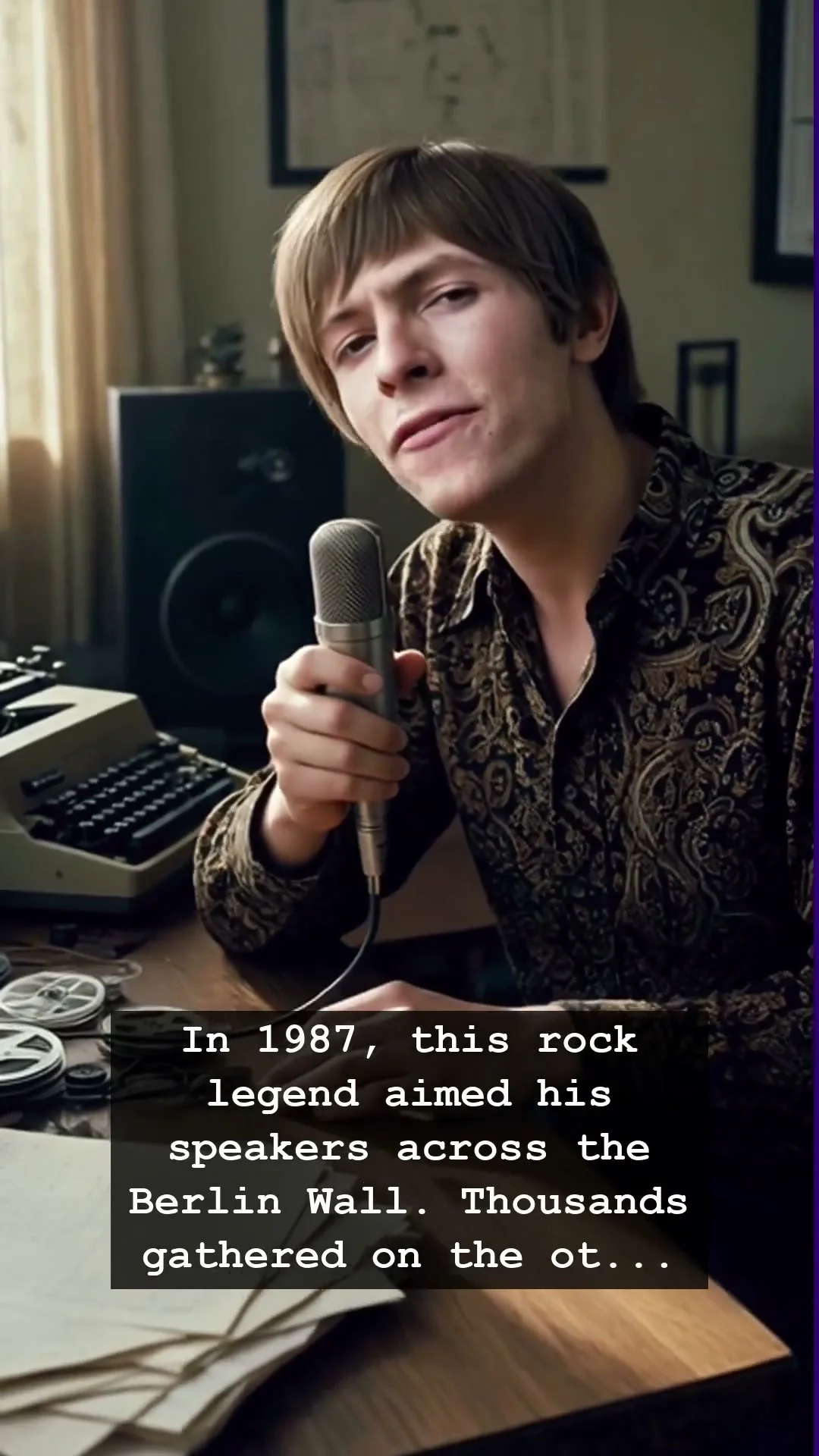
The year was 1987, and the world felt like it was held together by nothing more than tension and wire. In the shadow of the Berlin Wall, a concrete monolith that carved a jagged wound through the heart of Europe, David Bowie stood on a stage that would become the epicenter of an unlikely revolution. He wasn’t just performing a concert; he was staging an act of sonic defiance. With his iconic, chameleon-like charisma, David Bowie directed his speakers toward the East, sending the defiant anthems of freedom across the no-man’s-land. He didn’t know it then, but he was about to ignite a firestorm that would echo through the history books.
Thousands of young people, trapped behind the Iron Curtain, had gathered near the barrier, desperate to catch a sliver of the sound emanating from the West. For them, David Bowie was more than a rock star; he was a beacon of the life they were denied. As the chords of Heroes rippled through the cold night air, the atmosphere thickened with longing and raw energy. The local authorities in East Berlin, terrified by the cultural contagion spilling over the concrete, reacted with predictable brutality. They moved in with batons and steel, trying to silence the melody. What ensued was a chaotic, violent clash—a desperate struggle between the rigid fist of authority and the untamable spirit of youth fueled by rock and roll.
This was the era of the Walkman, where music was a private religion, and the concert stage was the only place where the public could truly feel the pulse of history. David Bowie, ever the master of the dramatic, understood the weight of the moment. He had spent years in West Berlin during the late seventies, absorbing the city’s gloomy, creative isolation, and he turned that melancholic genius into a weapon of hope. His performance was not merely about the music; it was a psychological operation of the soul, proving that melody could breach borders that tanks could never cross.
The riot that broke out that night was a testament to the power of art to threaten regimes. It wasn’t just another stop on a world tour; it was a flashpoint that foreshadowed the collapse of the wall just two years later. David Bowie, with his haunting vocals and enigmatic presence, had managed to do what politicians couldn’t—he made the people on the other side realize they weren’t alone. The screams of the crowd were not just of pain, but of a shared, forbidden joy that no guard tower could suppress.
Looking back, the legend of David Bowie remains tethered to this electric moment. It reminds us of a time when music held the power to change the map, when a guitar chord felt as heavy as a geopolitical shift. Today, we listen to those classic tracks and we still hear the echoes of that wall trembling. It is a story of music, rebellion, and the thin line between a concert and a revolution. Do you remember where you were when the music actually mattered, or are you still finding the strength to listen to the echoes of that night?