
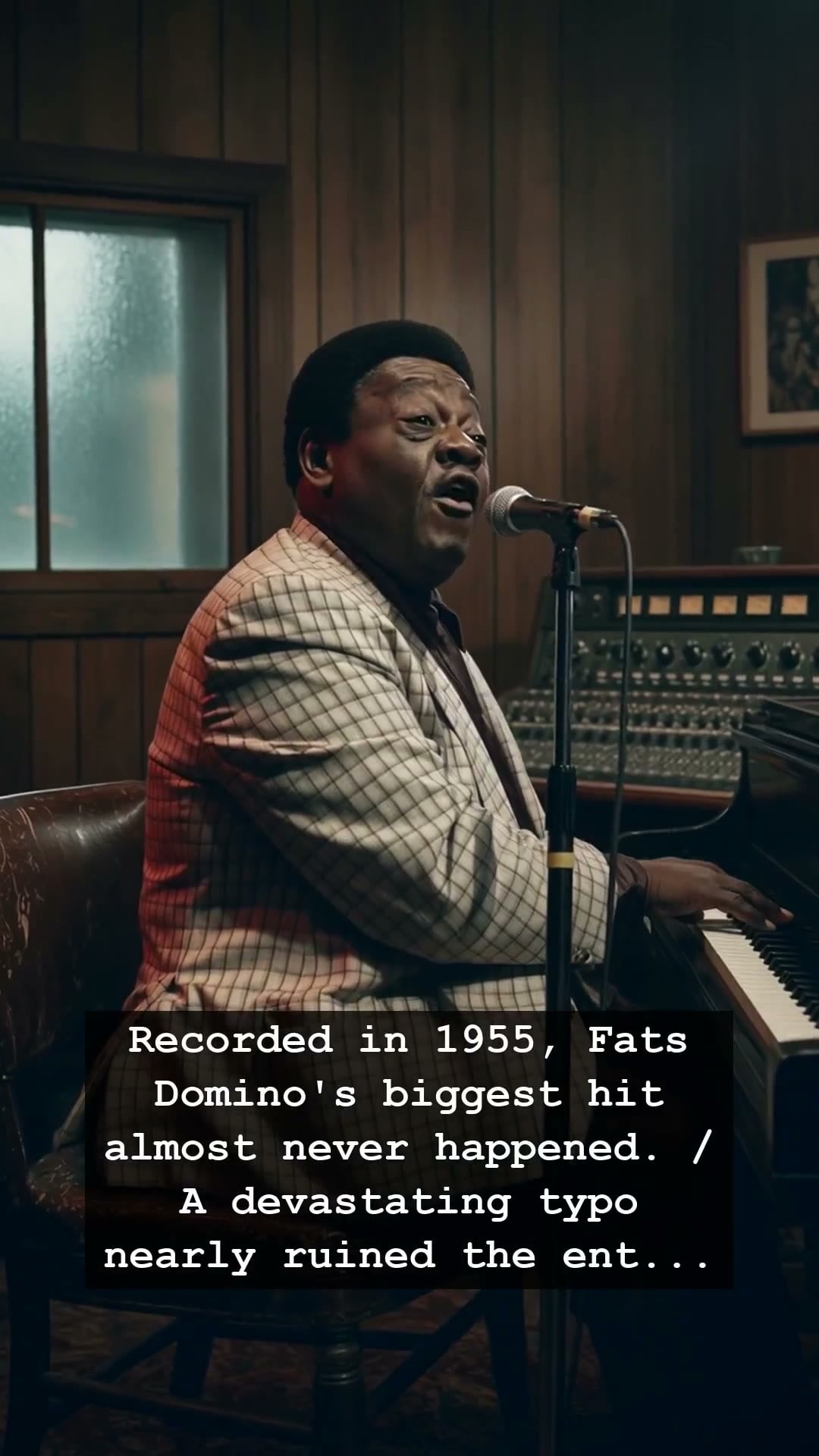
It was 1955, a year when the jukebox was the pulsing heart of every American diner and the air was thick with the scent of hair pomade and grilled burgers. Antoine ‘Fats’ Domino was already a legend in the making, a piano-thumping force of nature from New Orleans who brought the boogie-woogie spirit to the mainstream. Yet, one of the most iconic anthems of that golden era, Ain’t That a Shame, nearly vanished into the void of musical history before it ever truly hit the airwaves. The story of its release is a testament to the chaotic, often fragile nature of the early rock and roll industry, where a simple stroke of a pen almost derailed a chart-topping sensation.
As the story goes, the original title scribbled down for the session was actually ‘Ain’t It a Shame.’ It was a phrase common in the rhythm and blues circuits of the South, capturing a specific kind of heartache that Fats Domino delivered with unmatched grace and soul. However, when the time came to print the labels for the 45s, a devastating typo occurred. The title was printed as ‘Ain’t That a Shame.’ In the high-stakes, fast-moving world of mid-fifties record labels, a mistake like that could be enough to confuse listeners or lead to a total recall of the stock. It was a moment of profound frustration for the production team, who feared that this small error would strip the song of its authentic edge and leave it languishing on the shelves.
Against all odds, the record began to spin on radio stations across the nation, and the public didn’t seem to mind the typo at all. Fats Domino possessed a voice so warm and an ivory-tickling style so infectious that the change in vernacular became irrelevant. The song soared to the top of the charts, cementing his status as a pioneer of the genre. It wasn’t just a hit; it was a bridge between the segregated sounds of R&B and the burgeoning rock and roll movement that was about to set the youth culture on fire. The success of that record proved that raw talent and authentic groove could survive even the most clumsy industrial blunders.
Looking back, it is easy to romanticize the era of vinyl records and analog studios, but we often forget the sweat and the sheer unpredictability that fueled those timeless sounds. Fats Domino was a man who let the music do the talking, often soft-spoken in interviews but thunderous on the stage. His ability to connect with an audience, regardless of the label printed on the record sleeve, reminds us why we still turn to his music decades later. When that piano intro hits, you are transported back to a time when rock and roll was still finding its legs, untainted by the commercial cynicism that would arrive in later decades.
Even today, the legacy of Fats Domino remains firmly etched in the bedrock of American music. His influence ripples through the decades, from the early days of rock to the modern soul revivalists. Whenever I hear that familiar, rolling piano rhythm, I am reminded that perfection is rarely the goal; it is the soul and the grit beneath the surface that makes a song truly immortal. We invite you to listen to this legendary track again, closing your eyes and imagining the neon hum of 1955, and let the music remind you why it all mattered so much in the first place.