
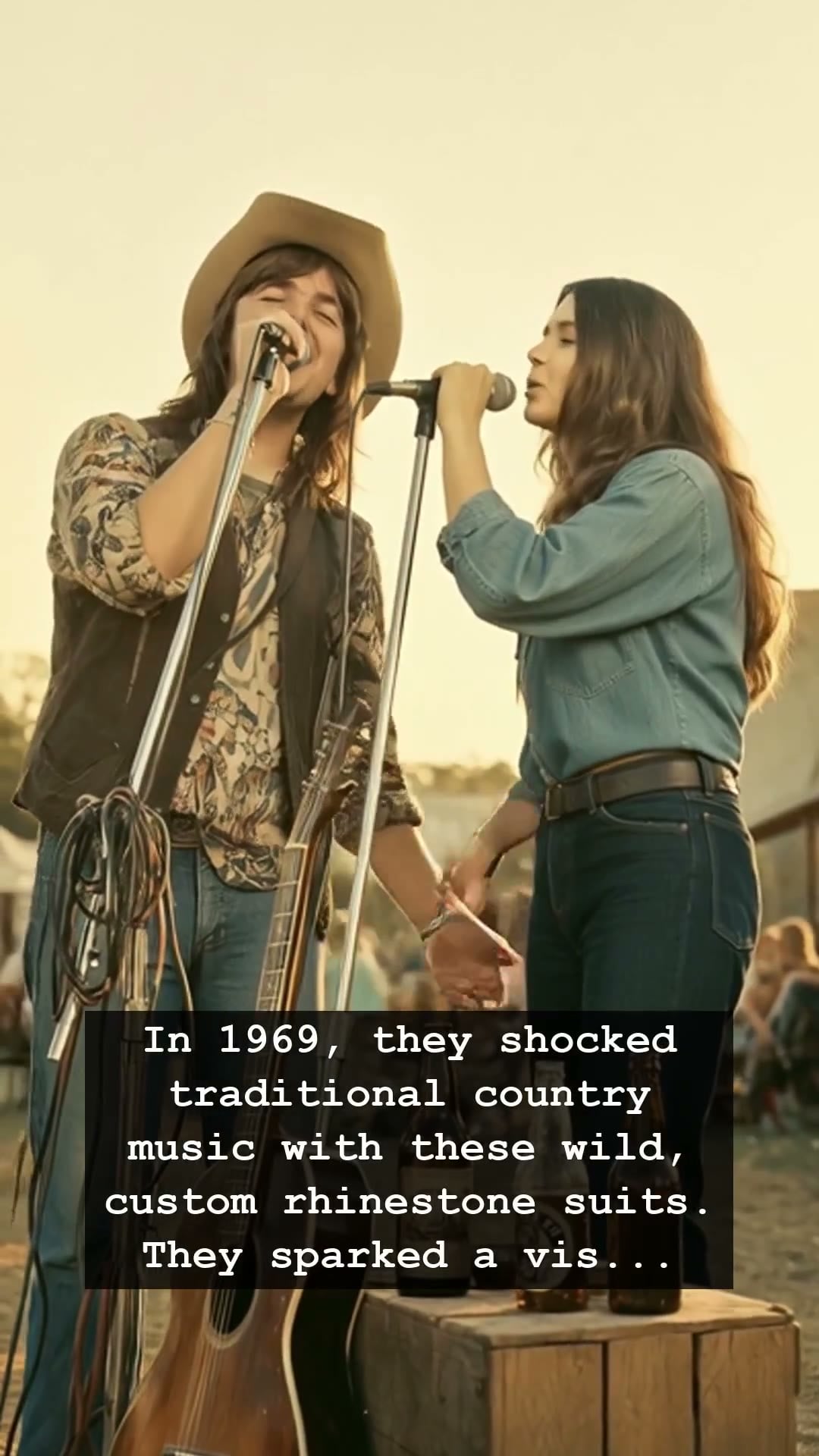
It was 1969, a year when the world felt like it was tilting on its axis, teetering between the fading optimism of the sixties and the gritty reality of the decade to come. In the heart of Nashville, a city built on tradition and the rigid rules of country royalty, two young men dared to commit an act that felt like artistic blasphemy. Gram Parsons and Bernie Leadon did not just walk onto the stage; they arrived like a visual fever dream. Adorned in custom, outrageously ornate rhinestone suits, they stood in front of an audience of conservative traditionalists who viewed them as interlopers. They weren’t just musicians; they were the vanguard of a movement that would bridge the gap between hippie counterculture and the soul of rural America.
To understand the gravity of this moment, one must remember that country music at the time was a guarded fortress. The rhinestones that Gram Parsons and Bernie Leadon wore were not merely decorative; they were subversive statements. By fusing the psychedelic experimentation of the Laurel Canyon scene with the teardrops-in-my-beer honesty of pure country, they defied every unspoken law of the Grand Ole Opry. It was the birth of Cosmic American Music, a genre that refused to be boxed in by geography or social class. Their partnership was a lightning rod, igniting a visual revolution that forced rock and roll to look at its roots and country to acknowledge its wild, untamed potential.
Behind the glitz of those shimmering suits lay a complex narrative of ambition, friction, and the relentless search for authenticity. Bernie Leadon, whose musical precision helped lay the groundwork for the future sound of the Eagles, provided the structural backbone to the ethereal, often self-destructive genius of Gram Parsons. Their collaboration was a delicate dance between the polished professionalism of the studio and the raw, unscripted chaos of the road. It was the era of the jukebox and the open highway, a time when music didn’t just play in the background—it defined the identity of a generation caught in transition.
Yet, the brilliance of Gram Parsons and Bernie Leadon was always haunted by the darker edges of the spotlight. The industry was changing, moving toward the glossy excesses of the seventies, yet these two remained tethered to a vision that was both nostalgic and radical. Their presence on stage was an invitation to dream, to look beyond the monochromatic constraints of the mainstream. For those of us who remember the smell of vinyl and the static of a transistor radio, their legacy serves as a reminder that the most powerful music often comes from those willing to break the status quo.
Decades later, the echo of their rhinestone-studded rebellion still rings true. They proved that identity is not a static concept but a costume we choose to wear in the face of judgment. As we look back, it is clear that they weren’t just playing music; they were rewriting the visual and sonic language of an entire nation. Do you remember the first time you heard the intersection of a twangy telecaster and a wandering soul?