
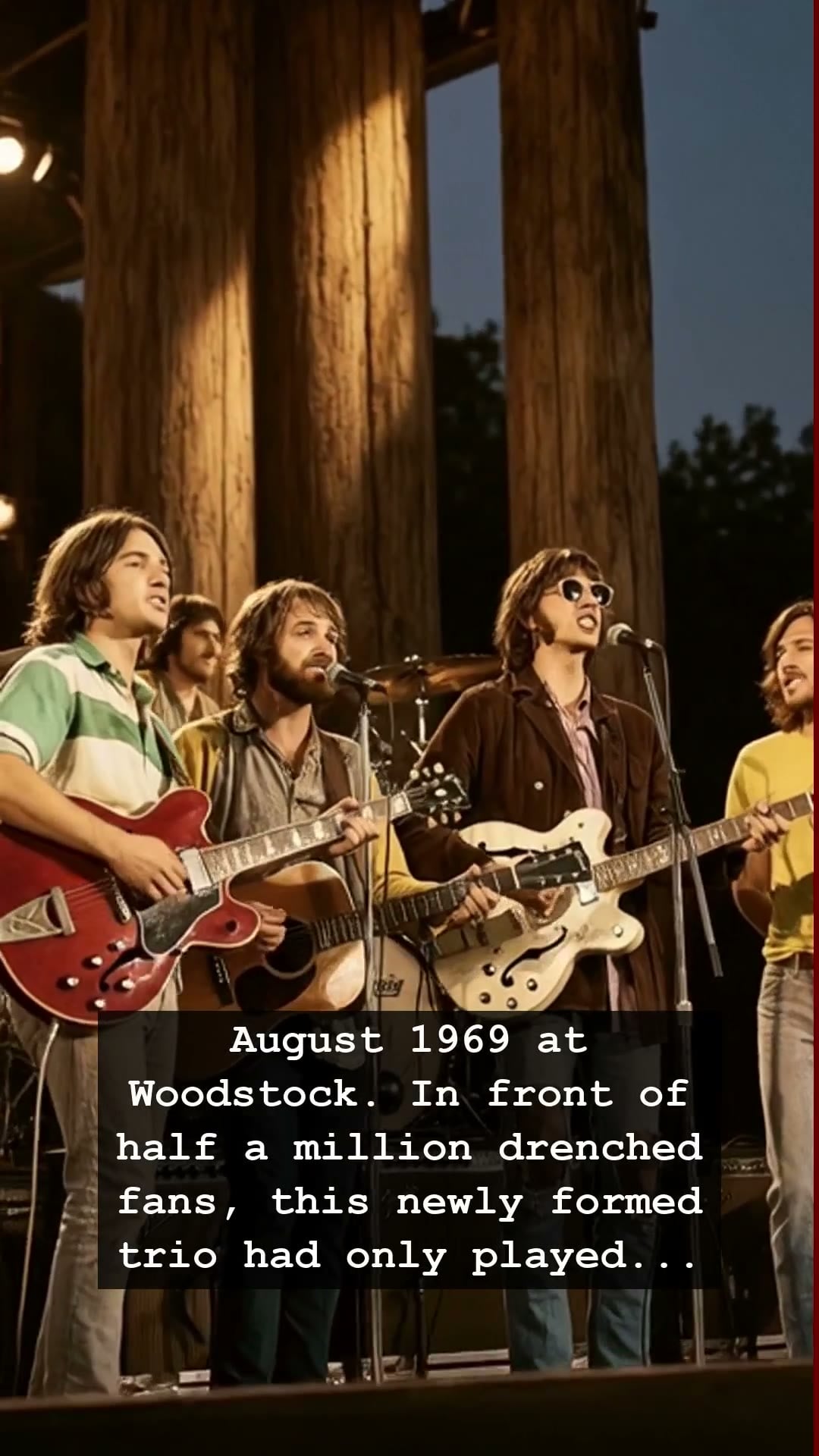
August 1969. The air at Woodstock was thick with the scent of mud, cheap patchouli, and the electric tension of half a million souls waiting for a miracle. Behind the stage, three men stood in the shadows, their hearts hammering against their ribs like trapped birds. They were Crosby Stills and Nash, a trio so fresh, so green, and so untested that they had only performed a single live gig before this moment. As they stepped into the harsh glare of the stage lights, staring out at a sea of drenched, exhausted, yet expectant faces, they were about to participate in a gamble that would define the sound of a generation. They were not just playing for a crowd; they were playing for history, completely unaware that their harmonies would become the heartbeat of a cultural revolution.
The genius of Crosby Stills and Nash lay in their terrifying vulnerability. Before the era of overproduced arena rock and polished digital tracks, their music relied on the raw chemistry of three distinct voices blending into something ethereal. David Crosby, Stephen Stills, and Graham Nash were already refugees from legendary acts like The Byrds, Buffalo Springfield, and The Hollies. Yet, here they were, stripped of their former identities, forging a new sound in the crucible of the sixties. That night at Woodstock, they faced the ultimate test of musical intimacy—three guitars, three voices, and no safety net. When they opened their mouths to sing, the cynicism of the decade seemed to dissolve, replaced by a soaring, melodic hope that resonated deep within the mud-caked hearts of the audience.
It is difficult for us today, living in the age of curated playlists and endless digital archives, to grasp the sheer audacity of that performance. There were no backing tracks, no visual spectacles, just the visceral power of song. The band’s interplay was not just a performance; it was a manifestation of the peace-and-love ethos that the era promised but rarely delivered in such a pure form. The drama behind their formation was real—egos were bruised, and the pressure of being the new supergroup was suffocating—but the second they harmonized, the friction between them vanished, replaced by a crystalline musical synchronicity that remains unmatched to this day.
As the festival turned into a mythological cornerstone of American culture, the legend of Crosby Stills and Nash only grew. They became the architects of a sound that bridged the gap between folk poetry and rock intensity. Their success proved that in the middle of chaos, beauty could still be constructed out of simple, resonant chords. Their sudden ascent to the top of the cultural mountain brought with it the inevitable shadows of fame, substance struggles, and the volatile creative tensions that would later define their long, tumultuous careers.
Decades later, the echoes of that 1969 performance still drift through our living rooms whenever we drop the needle on a vintage record. The magic of Crosby Stills and Nash survives because it captured a moment where the world felt like it was shifting on its axis. They didn’t just play a set; they provided the soundtrack for a generation searching for its own identity. If you ever find yourself wondering what the sixties truly felt like, listen to the harmonies they crafted under those stormy New York skies. It is a reminder that even the most fragile of human creations can stand the test of time.