
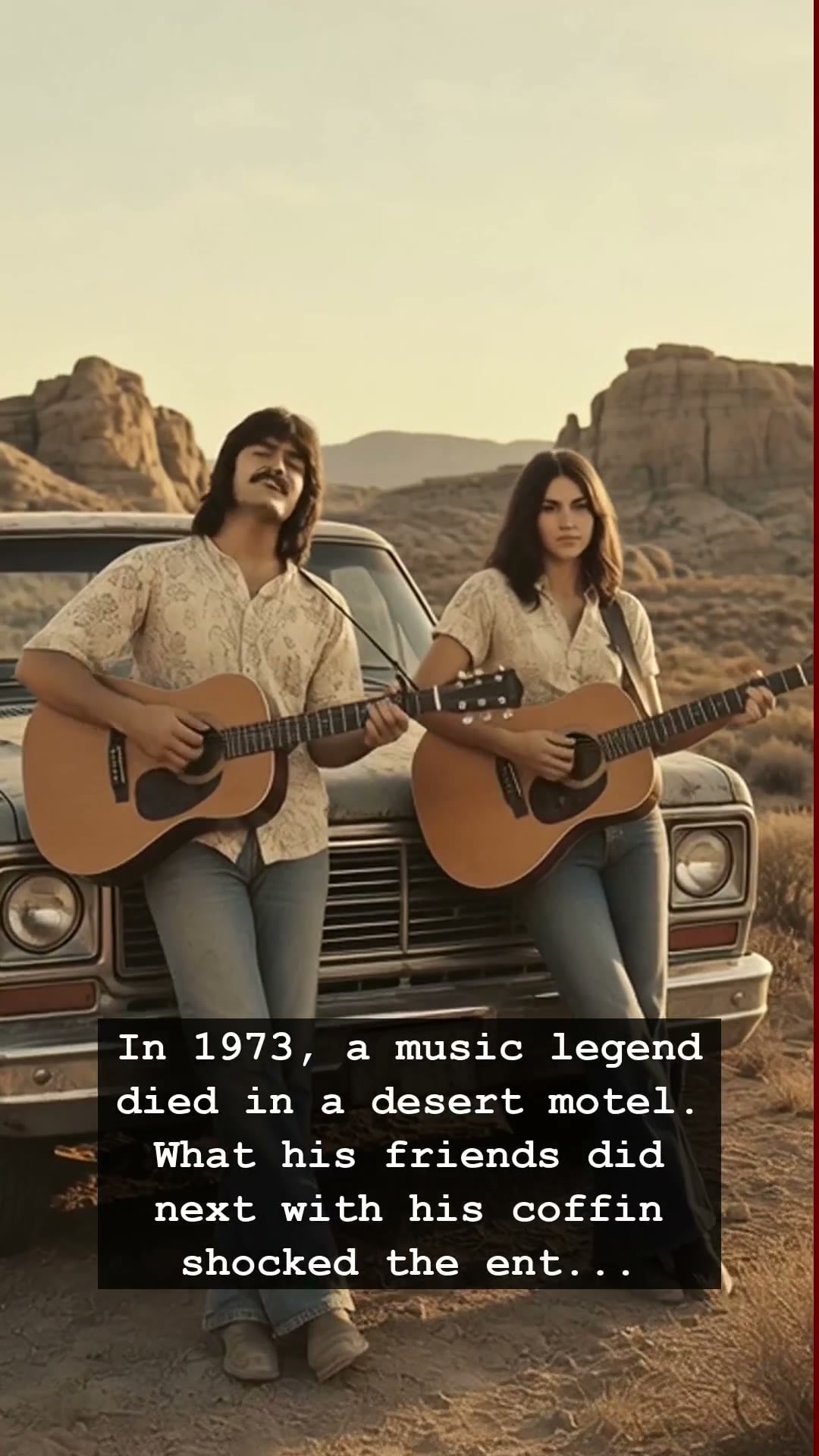
In the sweltering heat of September 1973, a legend died in room eight of the Joshua Tree Inn. Gram Parsons, the pioneer of cosmic American music, was only twenty-six years old. He was a man who bridged the gap between the lonesome twang of country and the rebellious pulse of rock, yet he left this world alone in a cheap motel room. His death was a tragic punctuation mark to a life lived in the fast lane, but it was not the end of his story. In fact, for Gram Parsons, the true drama began only after his heart stopped beating, sparking one of the most bizarre and misunderstood tributes in the history of music.
To understand the madness that followed, one must understand the era. Gram Parsons was a man haunted by the open road and the desolate beauty of the American West. He had influenced everyone from The Rolling Stones to The Byrds, weaving a tapestry of sound that felt like a dusty sunset on a highway. But as the seventies hit their stride, the indulgence of the era took its toll. When he died, his bandmates and closest companions were left not just with grief, but with a promise. They remembered his deep, spiritual obsession with the vast, mystical expanse of the Joshua Tree desert, where he felt most alive.
What happened next remains a shockwave in rock lore. Driven by a mix of alcohol, grief, and a twisted sense of devotion, his road manager Phil Kaufman stole the coffin from the airport terminal. They drove the hearse into the heart of the Mojave Desert, arriving at Cap Rock with a singular, fiery mission. They didn’t just want to bury their friend; they wanted to return his soul to the landscape that inspired his best work. They doused the casket in gasoline and ignited it, creating a funeral pyre that illuminated the desert floor in a haunting glow of orange and black.
This act of defiance against the establishment was not born of malice, but of a desperate, primal love. In an era before the polished sterility of modern fame, musicians lived by their own code. The industry was stunned, the authorities were outraged, but the legend of Gram Parsons was solidified forever. It was a moment of raw, unvarnished humanity that captured the spirit of a generation struggling to find meaning amidst the wreckage of their own excesses. It serves as a reminder that behind every masterpiece, there is often a broken human being reaching for something higher than the stage.
Decades later, the story of Gram Parsons still resonates because it reflects the duality of the American dream: the pursuit of greatness and the inevitability of the crash. As we look back at the era of Jukeboxes and late-night radio, his influence remains in every artist who dares to mix the grit of country with the fire of rock. While his end was shrouded in smoke and scandal, his music remains crystal clear, a lingering ghost in the desert air. We still listen to his records today, perhaps looking for a piece of that wild, untamed spirit he left behind in the Mojave.