
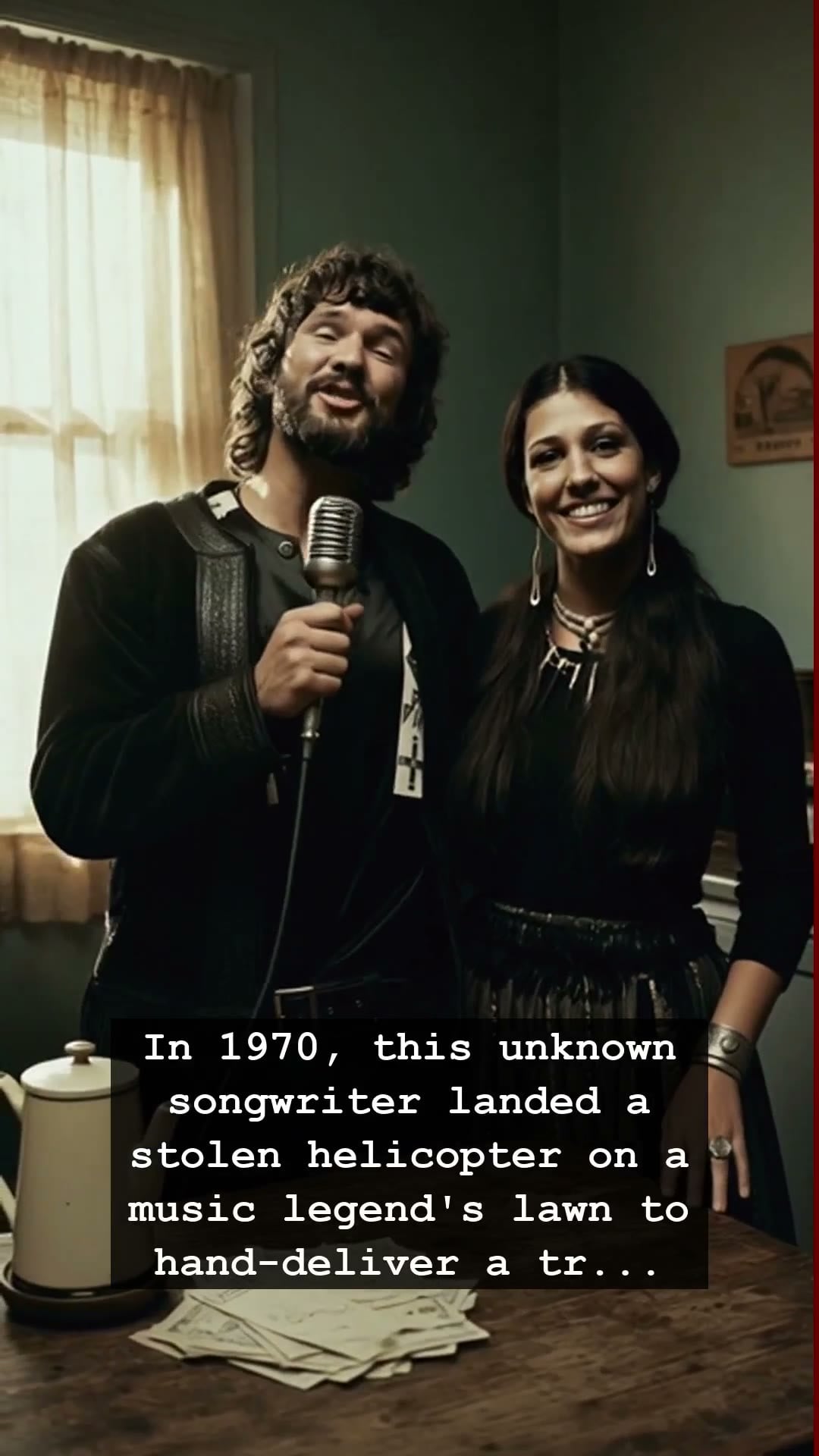
It was the golden age of American songwriting, a time when a simple lyric could shift the cultural landscape. In 1970, the air around Nashville was heavy with the scent of tobacco and the sound of jangling Telecasters. Most aspiring artists were content to wait in lines at record labels, hoping for a five-minute meeting with a jaded executive. But Kris Kristofferson was not built for waiting. Driven by a desperate, burning ambition and perhaps a touch of madness, he did the unthinkable. He didn’t just knock on the door of country music royalty; he descended from the heavens. With the roar of rotor blades shattering the quiet morning, Kris Kristofferson landed a stolen helicopter directly onto the manicured front lawn of the Man in Black himself, Johnny Cash.
Imagine the scene: Johnny Cash, a man who had seen everything from the grime of Folsom Prison to the bright lights of the Grand Ole Opry, walking out to his porch to find a disheveled pilot holding a demo tape. That pilot was Kris Kristofferson, a former Rhodes Scholar and Army captain turned janitor, holding onto a song he believed could save his soul. The song was Sunday Mornin’ Comin’ Down. It wasn’t just a track; it was a gritty, unfiltered portrait of loneliness and the lingering hangover of the sixties dream. When he handed that tape to Cash, the air in the room shifted. It was a moment of pure, cinematic tension, the kind that defined the volatile spirit of the era.
This was the era of the Jukebox hero, where songs like this found their home in smoky dives and late-night diners. Kris Kristofferson possessed an authenticity that was desperately needed. His lyrics were not polished for the radio; they were raw, bleeding, and profoundly human. By forcing his way into Johnny Cash’s orbit, he wasn’t just launching a career; he was sparking a revolution that bridged the gap between folk poetry and country grit. The song soon hit the airwaves, cementing itself in the American consciousness, proving that sometimes, you have to break the rules to be heard by the world.
Looking back, this story feels like a fable from a bygone time. We lived in a world of Woodstock idealism and the impending darkness of the disco decade, yet Kris Kristofferson stood as a bridge between these worlds. His audacity remains a testament to the power of belief. He proved that fame isn’t always about the slow climb, but about the willingness to take a risk so daring that history has no choice but to record it. That helicopter landing is now a piece of folklore, a jagged shard of truth in the polished history of American music.
Even today, in an age of digital streams and manufactured hits, the name Kris Kristofferson evokes a sense of rugged, unyielding integrity. When you listen to Sunday Mornin’ Comin’ Down, you can still hear the sound of the rotors, the desperation of the struggle, and the triumph of a man who refused to let his talent go unheard. It serves as a reminder that behind every legendary track, there is a human story—often one filled with rebellion, sweat, and a touch of wild defiance. Do you remember where you were the first time those lyrics stopped you in your tracks?