
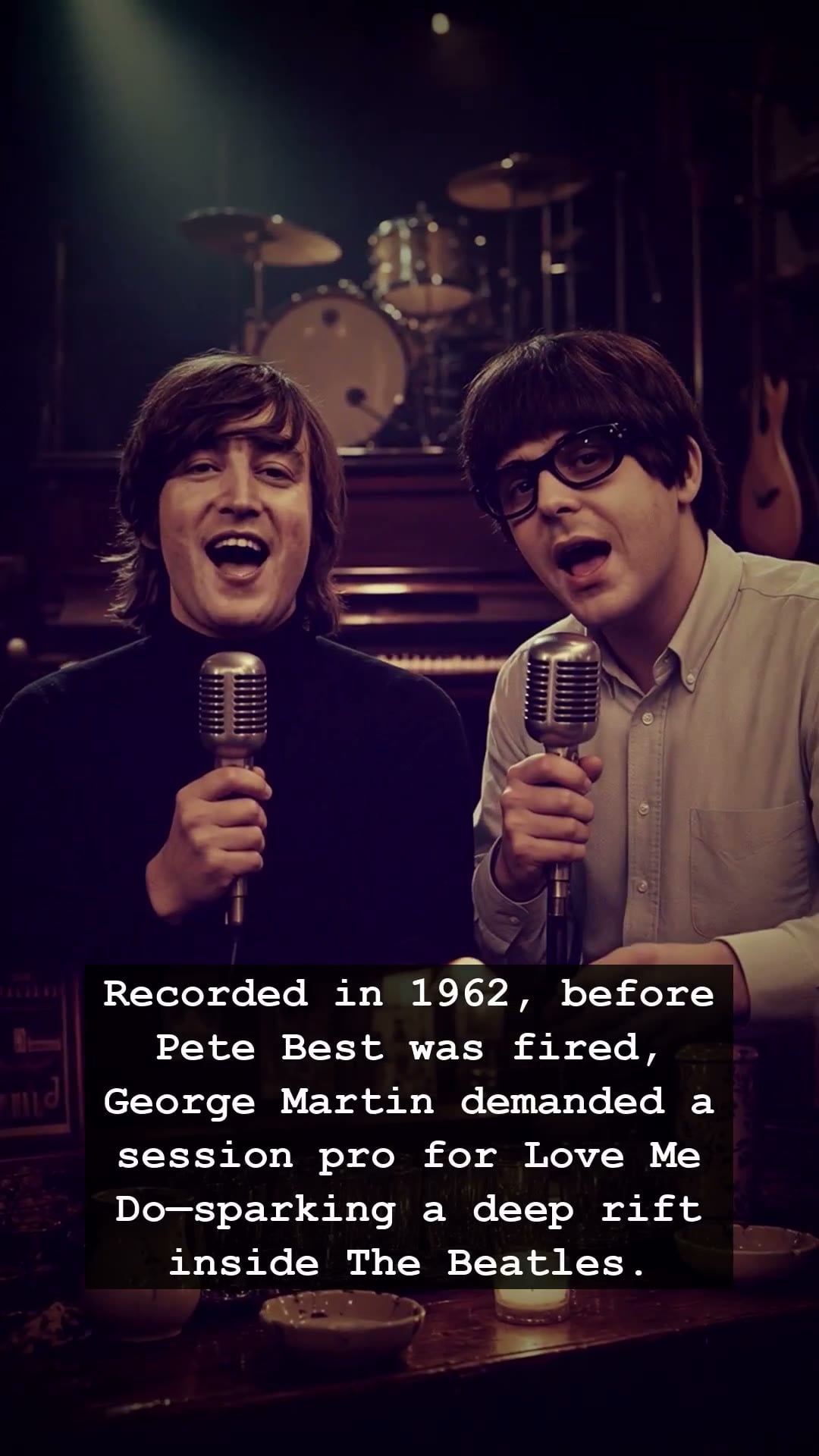
It was 1962, a year that smelled of hair pomade, cigarettes, and the electric tension of a changing world. Inside the cramped confines of EMI Studios, the air was thick with the weight of expectation. The Beatles, a raw and hungry quartet from Liverpool, were on the precipice of something massive. Yet, amidst the clatter of gear and the hum of vacuum tubes, a quiet demand from their producer, George Martin, sent a tremor through the band that would shatter their original lineup and leave a scar that never truly faded. Before the world knew the mop-top aesthetic, George Martin listened to the band’s initial recordings of Love Me Do and made a decision that felt, to the young men involved, like a betrayal of their brotherhood.
George Martin was a man of refined musical training, a stark contrast to the rough-and-tumble spontaneity of the four boys from Liverpool. When he insisted that a session drummer be brought in to replace Pete Best for the recording of their debut single, he wasn’t just adjusting a tempo; he was dismantling the emotional bedrock of the group. This was the moment the dream shifted from a collective of friends into a professional machine. The firing of Pete Best remains one of the most painful footnotes in rock and roll history, a brutal consequence of George Martin seeking the sonic perfection he knew would propel them to the top of the charts.
While the public was busy tuning their radios and dancing in the streets to the fresh, infectious energy of the Merseybeat sound, the internal dynamic of the band was undergoing a violent transformation. George Martin saw potential that the boys themselves hadn’t yet fully harnessed. He was the architect of their sound, pushing them to polish their rough edges, to harmonize tighter, and to experiment with the very texture of pop music. But this pursuit of greatness came at the cost of the band’s early innocence. The transition from Pete Best to Ringo Starr was not merely a swap of musicians; it was the birth of the definitive Beatles sound that would eventually define the entire sixties generation.
Looking back at that era, through the hazy lens of a vintage Walkman or the crackle of a worn-out vinyl disc, it is easy to view their success as inevitable. We forget the fragile, human messiness of it all. George Martin acted with a clinical coldness that many labeled cruel, yet history ultimately validated his intuition. He understood that to survive in the ruthless ecosystem of the music industry, The Beatles needed to be perfect. Without his intervention, perhaps the band would have remained a local club act, a footnote in the history of the Cavern Club rather than the legends of the century.
Today, when we hear the opening notes of Love Me Do, we are listening to a piece of history that was bought with a heavy price. We hear the echo of a session drummer and the steady hand of a producer who refused to settle for anything less than excellence. George Martin remains a titan of the industry, a man whose influence ripples through every studio recording that followed. It is a haunting reminder that behind every legendary track is a story of conflict, difficult choices, and the bittersweet realization that sometimes, to gain the world, you have to let go of a piece of your past.