
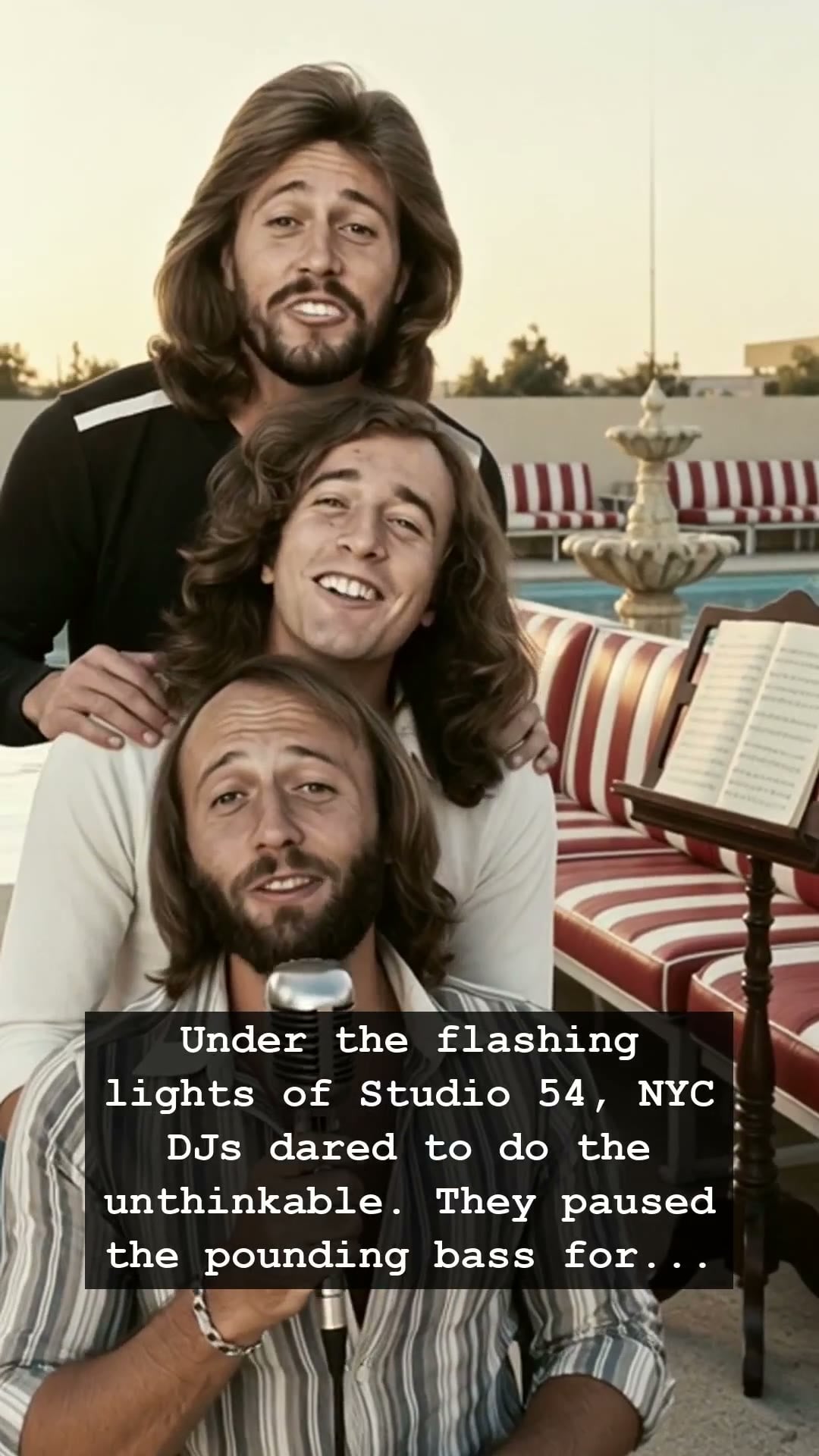
The year was 1978, and New York City was vibrating with the relentless, feverish pulse of disco. At the legendary Studio 54, the strobe lights were blinding, the velvet ropes were impassable, and the bass was a physical weight pushing against the ribs of every dancer. It was a cathedral of hedonism where the rhythm never died. Yet, in one of the most surreal moments in musical history, the DJs dared to do the unthinkable. They pulled the needle, let the pounding four-on-the-floor beat dissolve into thin air, and allowed a haunting, stripped-back ballad to fill the cavernous room. The hundreds of exhausted, sweat-drenched dancers didn’t revolt; they fell completely, breathlessly silent as the Bee Gees transformed the dancefloor into a place of profound vulnerability.
Most people remember the Bee Gees as the kings of the mirror ball, the falsetto-voiced architects of Saturday Night Fever who defined the glitter and excess of the late seventies. But before the white suits and the chart-topping disco anthems, Barry, Robin, and Maurice Gibb were masters of the melancholic melody. Their journey was not merely one of fame, but of constant reinvention fueled by intense sibling rivalry and the pressure of global superstardom. The song that cut through the noise of Studio 54 that night was not a high-tempo dance track, but a reminder of the emotional depth that had always been the backbone of the Bee Gees’ songwriting brilliance.
This shift in the atmosphere revealed something hidden beneath the disco veneer. The Bee Gees were often dismissed by critics as mere producers of plastic pop, yet their ability to tap into universal longing remained unmatched. In that darkened club, when the heavy bass finally gave way to their signature harmonies, the mask of the disco era momentarily slipped. It was a moment of raw human connection in an age of calculated artifice. The audience, usually caught in the relentless cycle of the night, suddenly found themselves reflective, swaying to a sound that predated the neon lights, a sound that spoke to the heartache lurking beneath the glamour.
It is this duality that makes the Bee Gees’ legacy so enduring. They were the bridge between the baroque pop of the sixties and the polished synth-driven future. Behind the scenes, the brothers weathered the storms of substance abuse, the crushing weight of public opinion, and the constant fear of irrelevance. They were human beings caught in a whirlwind, using their music to ground themselves even as they soared to the top of the Billboard charts. That night at Studio 54 wasn’t just a gimmick; it was a testament to the fact that, regardless of the era, the soul of a song will always override the tempo.
Today, we look back at the late seventies through a lens of nostalgia, seeing the Bee Gees not just as icons of a genre, but as survivors. They captured the spirit of a generation that wanted to dance away its troubles, even while they sang the songs that made them cry. When you put on their records today, you aren’t just hearing disco; you are hearing the ghosts of a thousand nights spent under the spinning lights, searching for a feeling that would never truly end. Their music remains a haunting reminder that in the heat of the party, sometimes silence is the most powerful dance of all.