
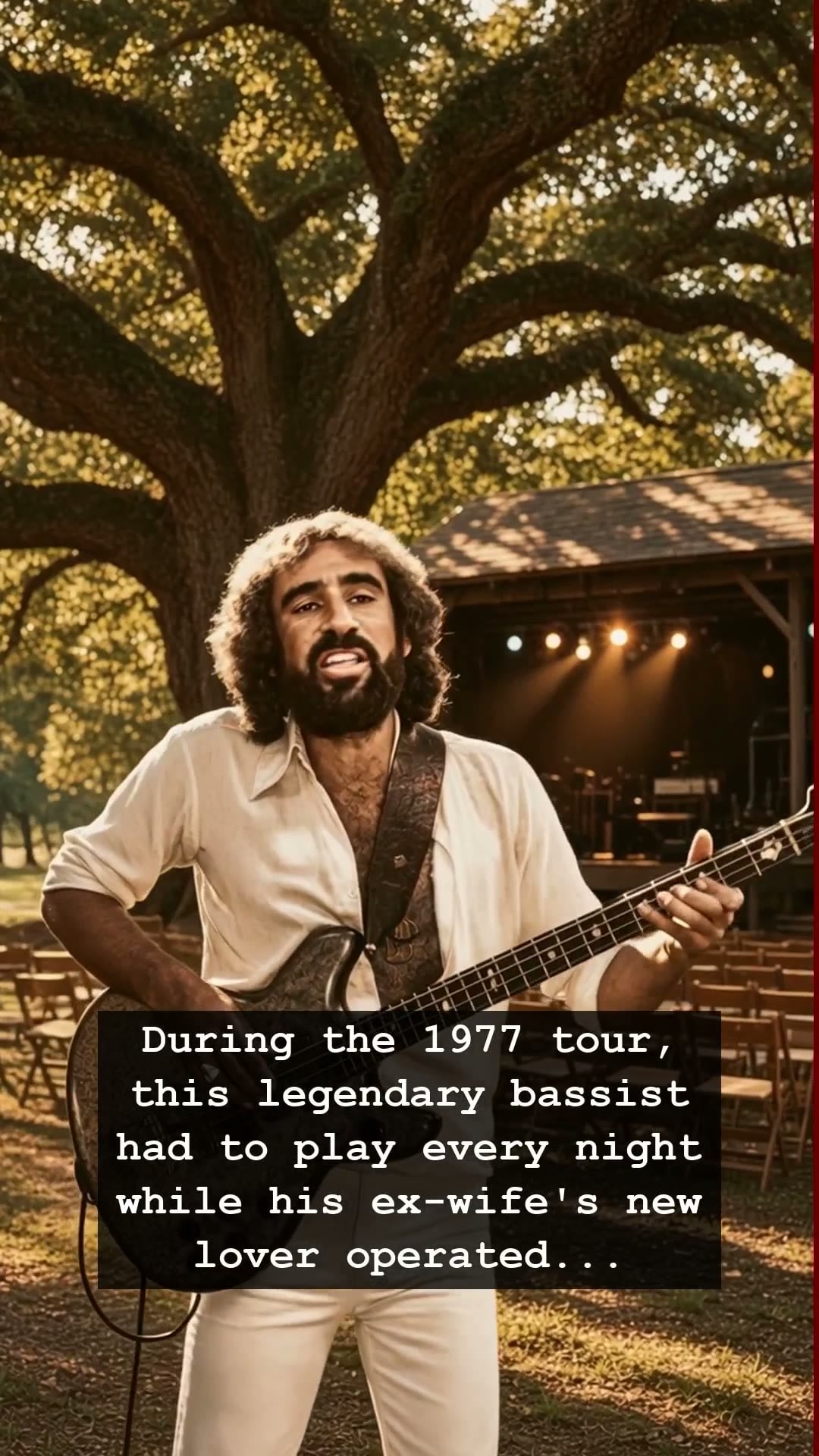
It was the golden age of rock, a time when the hum of a cassette Walkman could soundtrack your entire world and the jingle of a jukebox defined a Friday night. But behind the shimmering harmonies of Fleetwood Mac, a different kind of sound was echoing through the rafters—the sound of hearts breaking in real time. Imagine standing on a stage in 1977, bathed in the blinding glare of stadium lights, locked into a bass groove that anchors a chart-topping hit. Now, imagine that the song you are playing was written by your ex-wife about her new lover, and that very man is the one operating the concert spotlights from the rafters above you. This was the haunting, daily reality for John McVie during the Rumours tour.
John McVie, the stoic backbone of one of the world’s greatest bands, found himself in a psychological pressure cooker that few musicians have ever endured. After his marriage to Christine McVie dissolved, the band didn’t break up; they did something far more reckless. They poured their gasoline-soaked emotions into the recording studio. By the time they hit the road to support their masterpiece, the internal dynamics of the band were a tangled web of resentment, longing, and artistic brilliance. John McVie had to witness the woman he once loved singing lyrics she penned for a new flame, night after night, while the man behind those lyrics often watched from the shadows of the lighting rig.
There is a specific, jagged edge to the basslines John McVie laid down during this era. Perhaps it was the adrenaline of the fame, or perhaps it was the sheer necessity of professional survival that gave his playing such a deep, resonant gravity. The 1977 tour remains a legendary moment in musical history, representing the absolute zenith of 70s Arena Rock excess and emotional transparency. Fans were captivated by the raw vulnerability on display, never fully realizing that the chemistry they adored was actually a byproduct of five people barely holding their lives together while under the intense microscope of international superstardom.
This level of artistic sacrifice is nearly impossible to conceive in our modern, disconnected era. John McVie became a master of stoicism, channeling his private agony into the rhythmic pulse that kept the band from flying apart. He didn’t quit, and he didn’t falter. He simply played, night after night, acting as the foundation for the very songs that chronicled his own heartbreak. It is this authentic, gut-wrenching drama that has kept the legacy of Fleetwood Mac alive long after the smoke cleared from those 70s arenas.
Decades later, we still reach for our records when we need to feel something real. We look back at John McVie and his peers not just as icons, but as humans who lived through the fire of the music industry’s most chaotic chapter. Their story is a testament to the idea that the greatest art is often forged in the deepest suffering. Next time you drop the needle on that record, listen closely to the bass—you are hearing a man who survived the impossible just to keep the music playing.