
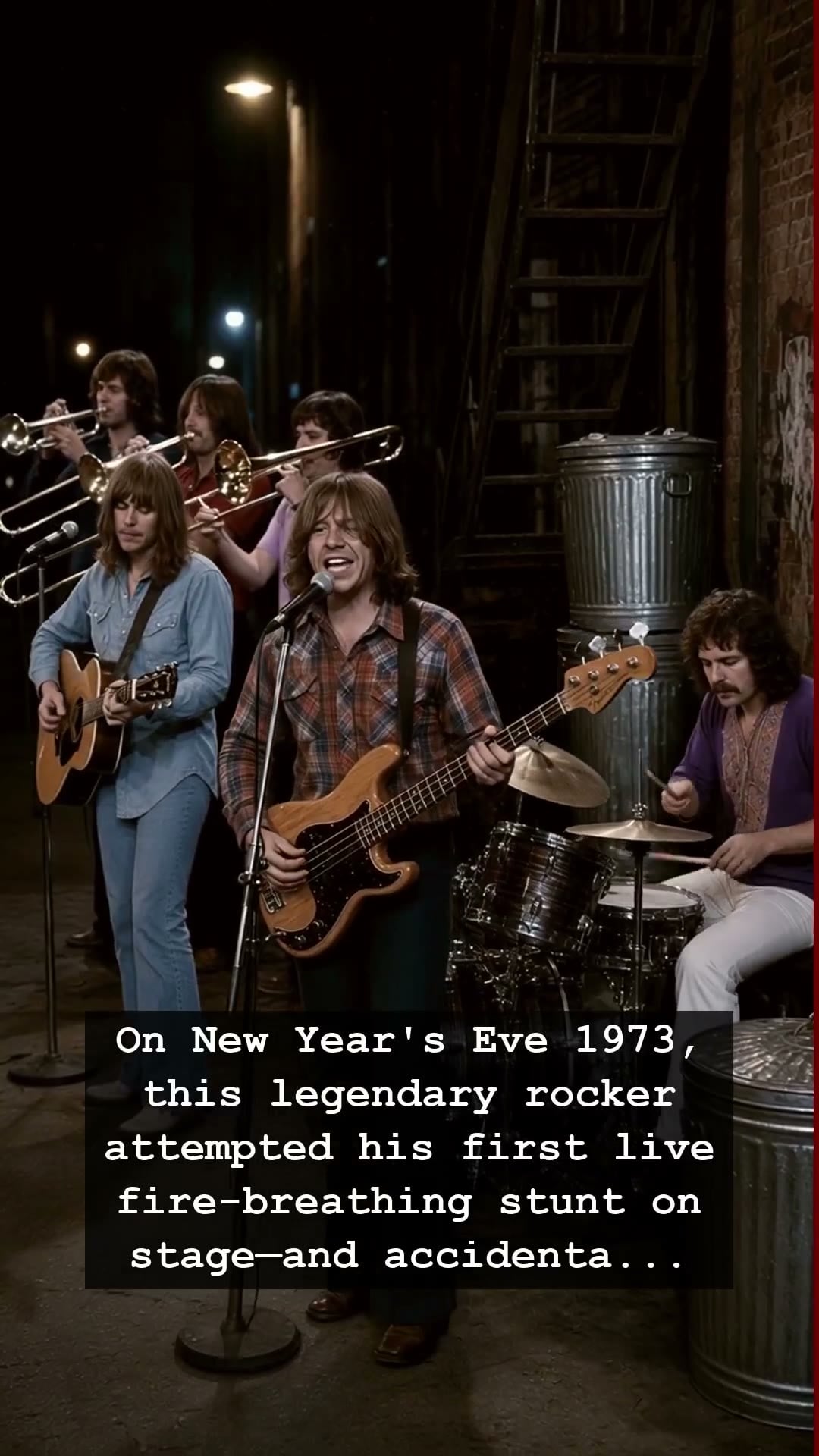
The year was 1973. The air was thick with the scent of cheap beer, stale smoke, and the unbridled ambition of a band desperate to escape the obscurity of the New York club circuit. On New Year’s Eve, at the Academy of Music, a young Gene Simmons—not yet the global icon of excess we know today—decided that his stage performance needed more than just platform boots and white face paint. He needed fire. He needed to be a demon, not just in spirit, but in truth. As the clock ticked toward midnight, the band prepared for their first attempt at a professional fire-breathing stunt. It was a reckless, experimental, and inherently dangerous moment that defined the volatile spirit of the seventies.
Gene Simmons stood center stage, his hair teased into the gravity-defying, aerosol-heavy mane that would soon become a signature of the era. He took a deep breath, channeled his inner monster, and attempted to spit a stream of fuel into the air above a torch. He miscalculated. The laws of chemistry are unforgiving, and the excessive hairspray coating his hair turned his head into a literal fuse. In a sickening flash of orange light, the heat traveled upward. Suddenly, the future face of KISS was not just performing; he was being consumed by his own spectacle. The crowd, expecting a choreographed trick, watched in genuine horror as their bassist was briefly transformed into a living, screaming torch.
This terrifying accident was a dark baptism for a band destined to dominate the arena rock scene of the eighties. It captures the raw, often lethal desperation of musicians in the pre-digital age who were willing to risk their lives for the sake of a spectacle. Before pyrotechnics were controlled by safety technicians and computer algorithms, they were handled by hungry artists in smoky basements. For Gene Simmons, that night served as a grim reminder of the fine line between showmanship and catastrophe. It wasn’t just a burn; it was a defining moment of rock and roll’s reckless, unpolished infancy, far removed from the pristine polish of modern MTV broadcasts.
Why does this story still resonate with us decades later? It reflects the deep nostalgia we feel for a time when music was tangible, dangerous, and sometimes genuinely frightening. Gene Simmons would go on to build a multi-million dollar empire on the foundation of that image, but the legend of the fire-breathing debacle remains a grounding human error in the mythos of a rock god. It reminds us that behind the makeup and the bravado, these legends were just young, scared, and ambitious individuals playing with fire—quite literally—to capture our attention.
As we look back at the era of the Jukebox and the rise of hard rock, we remember these moments not as mistakes, but as the sparks that ignited a cultural wildfire. Whether you were there in the front row or discovered their music years later through a worn-out cassette, the legend of Gene Simmons continues to loom large. The next time you listen to a classic anthem, remember that behind every great performance is a history of trial, error, and perhaps a singed eyebrow or two. Keep the music loud and the memories alive.