
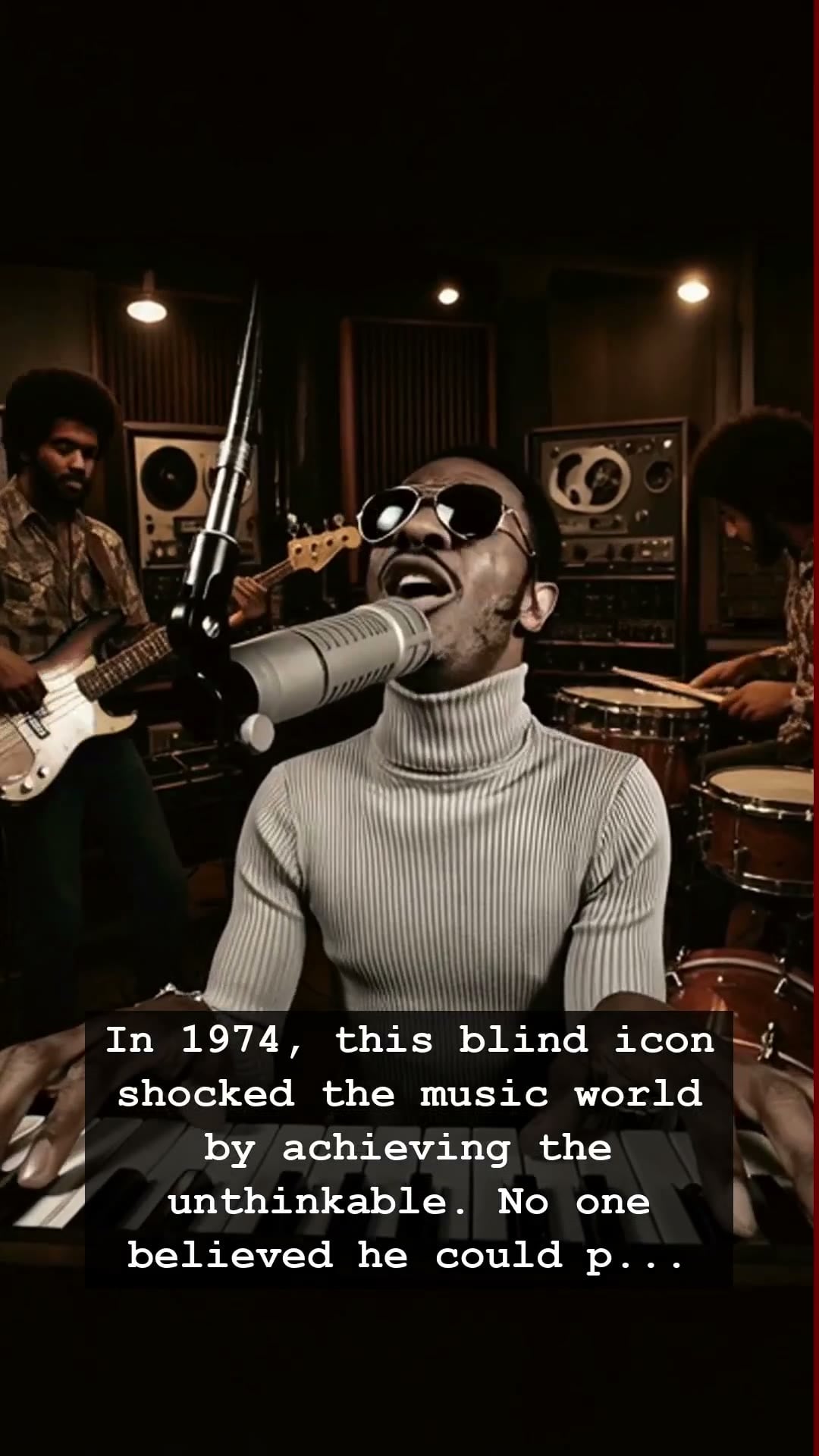
In the golden era of the 1970s, when the world was glued to their hi-fi speakers and the cultural landscape was shifting under the neon glow of disco and soul, one man was quietly redefining the impossible. Picture the scene: 1974, a time when the industry was ruthless, and critics often dismissed artists who dared to push the boundaries of sound. Then came Stevie Wonder, a man who saw the world through a lens of pure sonic genius rather than light. He didn’t just release another record; he ignited a three-year revolution that left the music establishment trembling in their velvet-lined offices.
Most artists pray for a single career-defining moment, a solitary brush with immortality. Yet, Stevie Wonder did the unthinkable, securing the Album of the Year Grammy for three consecutive records: Innervisions, Fulfillingness First Finale, and the magnum opus, Songs in the Key of Life. It was a legendary three-peat that shattered every expectation. At a time when the industry was obsessed with visual spectacle and the rapid rise of MTV, Stevie Wonder proved that the true weight of a legend rests entirely on the vibration of the soul. He wasn’t just performing; he was channeling an entire generation’s hopes, struggles, and dreams into tape reels that still echo today.
The drama behind these masterpieces was as intense as the music itself. Navigating the treacherous waters of the 1970s, Stevie Wonder battled the corporate giants of Motown to secure total creative control, a move that was practically unheard of for a Black artist at the time. He retreated into the sanctuary of the recording studio, obsessively crafting synth textures and complex rhythmic tapestries that felt like they were pulled from another dimension. These sessions were not just work; they were grueling, late-night experiments involving his beloved synthesizers, pushing his musicians to the absolute brink of perfectionism.
There is a haunting beauty in knowing that while Stevie Wonder lived in darkness, he saw the world more vividly than any of his contemporaries. His music became the soundtrack to the post-Woodstock era, bridging the gap between the raw grit of Motown and the sophisticated soul that would dominate the decade. He carried the weight of a changing nation on his shoulders, infusing his lyrics with social commentary that remains relevant, poignant, and eerily prophetic even decades after the needles left the grooves of those original pressings.
Today, we look back at his achievements not merely as statistical triumphs, but as a testament to the stubborn persistence of genius. Whenever you drop the needle on one of his classics, you aren’t just listening to a track; you are stepping into a time capsule that vibrates with the pulse of the 1970s. Stevie Wonder remains the ultimate benchmark for what an artist can achieve when they refuse to compromise. As the world continues to spin, his melodies remain our constant, steady heartbeat, reminding us all that true magic never fades—it simply finds a new soul to move.