
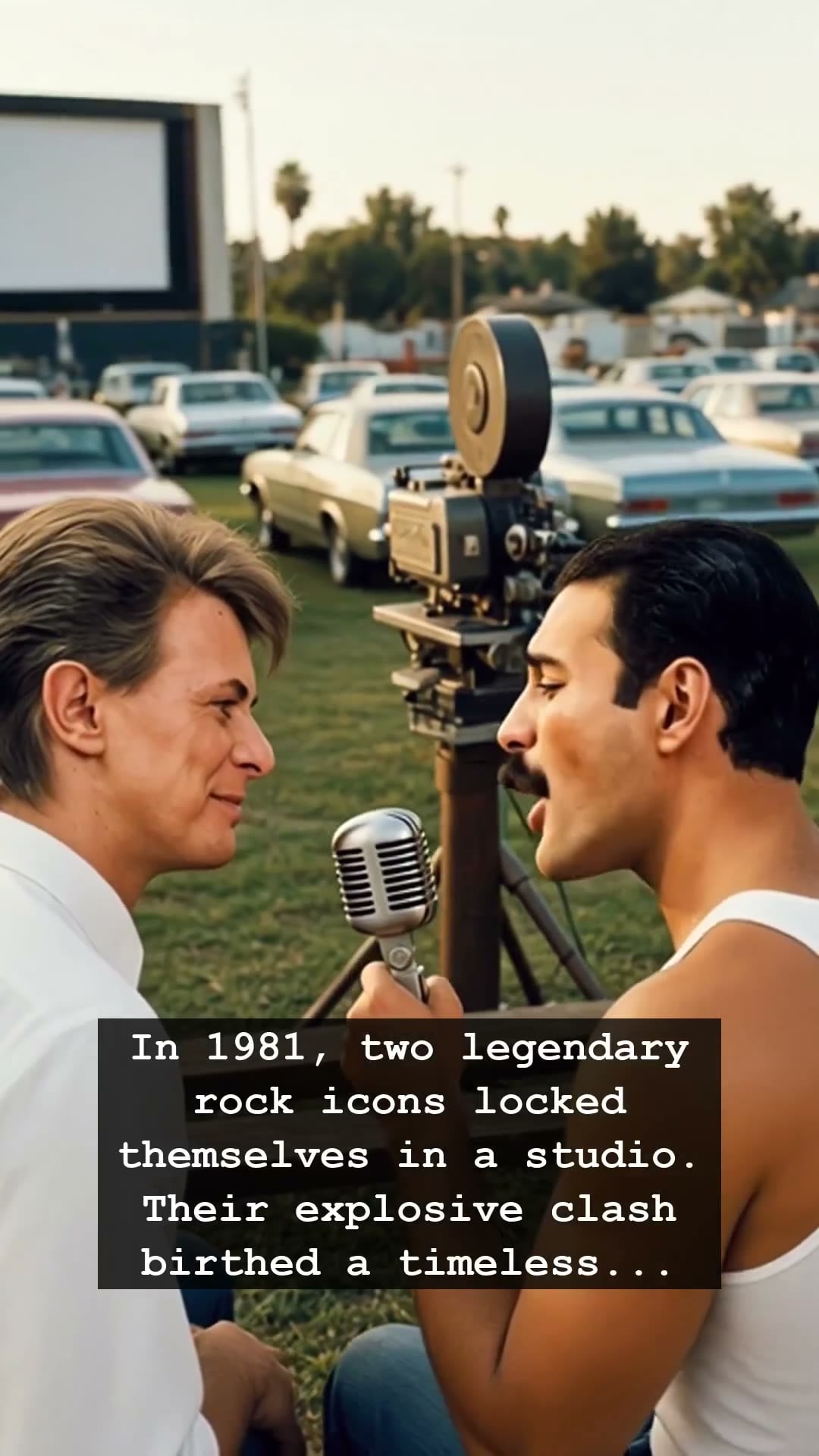
In the summer of 1981, the sleepy town of Montreux, Switzerland, became the unlikely battleground for a clash of titans. Inside the legendary Mountain Studios, two of music’s most flamboyant and uncompromising architects, Freddie Mercury and David Bowie, found themselves locked in a room together. The air was thick with cigarette smoke, the hum of analog gear, and an ego-fueled tension that left the studio staff bracing for a total creative meltdown. This was not just a recording session; it was a high-stakes collision of two towering geniuses who had reached the pinnacle of rock superstardom.
At the time, Freddie Mercury was the golden god of Queen, commanding stadium-sized crowds with theatrical precision, while David Bowie was the chameleonic visionary who had spent a decade reinventing the very definition of pop art. Bringing these two together was like mixing nitroglycerin with a flame. They spent hours arguing over melodies, phrasing, and the direction of the track, pushing one another to their psychological limits. It was a chaotic process fueled by perfectionism and, according to legend, a fair amount of wine. The recording session was reportedly so fraught with disagreements that witnesses feared the collaboration would end in a bitter stalemate before a single note was mastered.
Yet, out of that explosive friction emerged one of the most iconic songs in the history of popular music: Under Pressure. The song’s defining bassline, famously plucked out by John Deacon, provided a pulsating, hypnotic foundation for a vocal performance that remains etched in the DNA of the 1980s. When you hear that opening thrum, you are immediately transported back to a time when MTV was just beginning to dictate culture and the cassette-playing Walkman was the ultimate status symbol of youth. The track captured a sense of urgent, existential anxiety that defined the turn of the decade, perfectly mirroring the personal and professional pressure both Freddie Mercury and David Bowie were navigating behind the scenes.
Beyond the technical brilliance, the song is a testament to the transformative power of conflict. Freddie Mercury and David Bowie were two artists who typically did not take directions from anyone. Watching them trade lines, with Freddie’s operatic range soaring against David Bowie’s gritty, soulful delivery, reveals a rare moment of vulnerability and raw competition. They didn’t just record a track; they forged a sonic document of their era, showcasing a chemistry that could only be ignited by two people who were equally obsessed with pushing the boundaries of what rock music could achieve.
Decades later, the song serves as a poignant reminder of the sheer magnitude of their talent. As we look back through the lens of nostalgia, the story of their Swiss studio sessions reminds us that even the most immortal anthems often rise from the ashes of artistic ego and uncertainty. Whether it was the strobe lights of a discotheque or the hum of a radio, their collaboration became the soundtrack for a generation. It stands as a defiant, beautiful legacy—a frozen moment in time where two musical kings dared to collide and ended up changing history forever.