
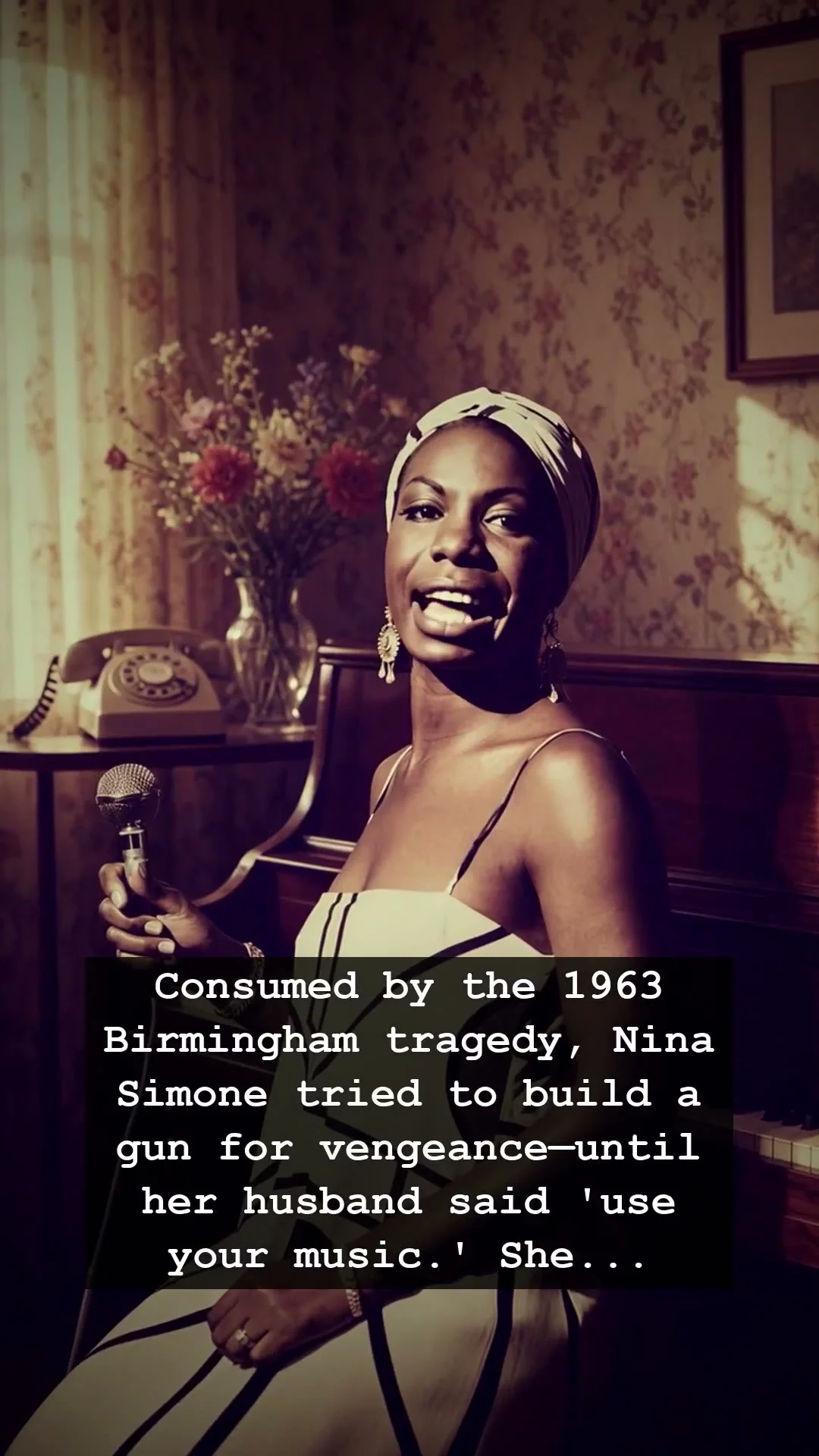
The year was 1963, a time when the crackle of a radio could bring news that shattered the American soul. In the heat of the Civil Rights movement, the horrific 16th Street Baptist Church bombing in Birmingham, Alabama, sent shockwaves through the nation, claiming the lives of four innocent young girls. For Nina Simone, the legendary high priestess of soul, this was not just a news headline—it was a visceral, personal assault on her humanity. The fury that consumed her was so profound that she retreated into her home, gripped by a singular, dark desire: to arm herself. She began gathering materials to build a homemade gun, determined to take vengeance into her own hands. The world of music almost lost one of its most potent voices to an act of irreversible violence.
Her husband, Andy Stroud, stood in the doorway, witnessing a woman he barely recognized, trembling with the weight of unspeakable trauma. He didn’t offer platitudes; instead, he offered a redirection that would change the course of music history. He looked at her and told her to put down the weapon and go to the piano instead. In that moment of profound clarity, Nina Simone sat down at her instrument. Her fingers, usually accustomed to the delicate intricacies of jazz and classical arrangements, began to hammer out a different kind of rhythm—a rhythm of protest and raw, unadulterated pain. In under an hour, Mississippi Goddam was born, a song so searing and uncompromising that it was banned across several Southern states upon its release.
Nina Simone was never one to soften her edges for the comfort of the mainstream. During an era where artists were often pressured to remain silent on social issues, she stood as a defiant pillar of truth. Mississippi Goddam was not merely a protest song; it was a psychological exorcism. She once famously remarked that she had to be a mirror to her time, reflecting the turmoil of the era back to the people who refused to see it. While many of her peers were crafting pop hits for the jukebox, she was using her craft to document the brutal reality of a segregated America, forever linking her legacy to the struggle for justice.
Even today, the track resonates with a haunting urgency. Listening to the recording, you can almost feel the smoke and the collective grief of the early 1960s. It stands as a testament to the power of artistic transformation—how one woman channeled a murderous rage into a piece of art that served as a rallying cry for an entire generation. It is this authentic, often painful intensity that makes Nina Simone an immortal figure in our musical landscape. She proved that when the world is burning, the most dangerous weapon is not made of steel, but of melody and truth.
As the decades pass, we look back at the era of vinyl records and civil unrest, and we see Nina Simone not just as a performer, but as a chronicler of the human condition. Her journey from the brink of tragedy to the heights of artistic revolution remains one of the most compelling stories in the history of American music. When you listen to her voice today, you are hearing the echo of a woman who refused to be silenced, choosing instead to turn her own personal trauma into a universal anthem for change.