
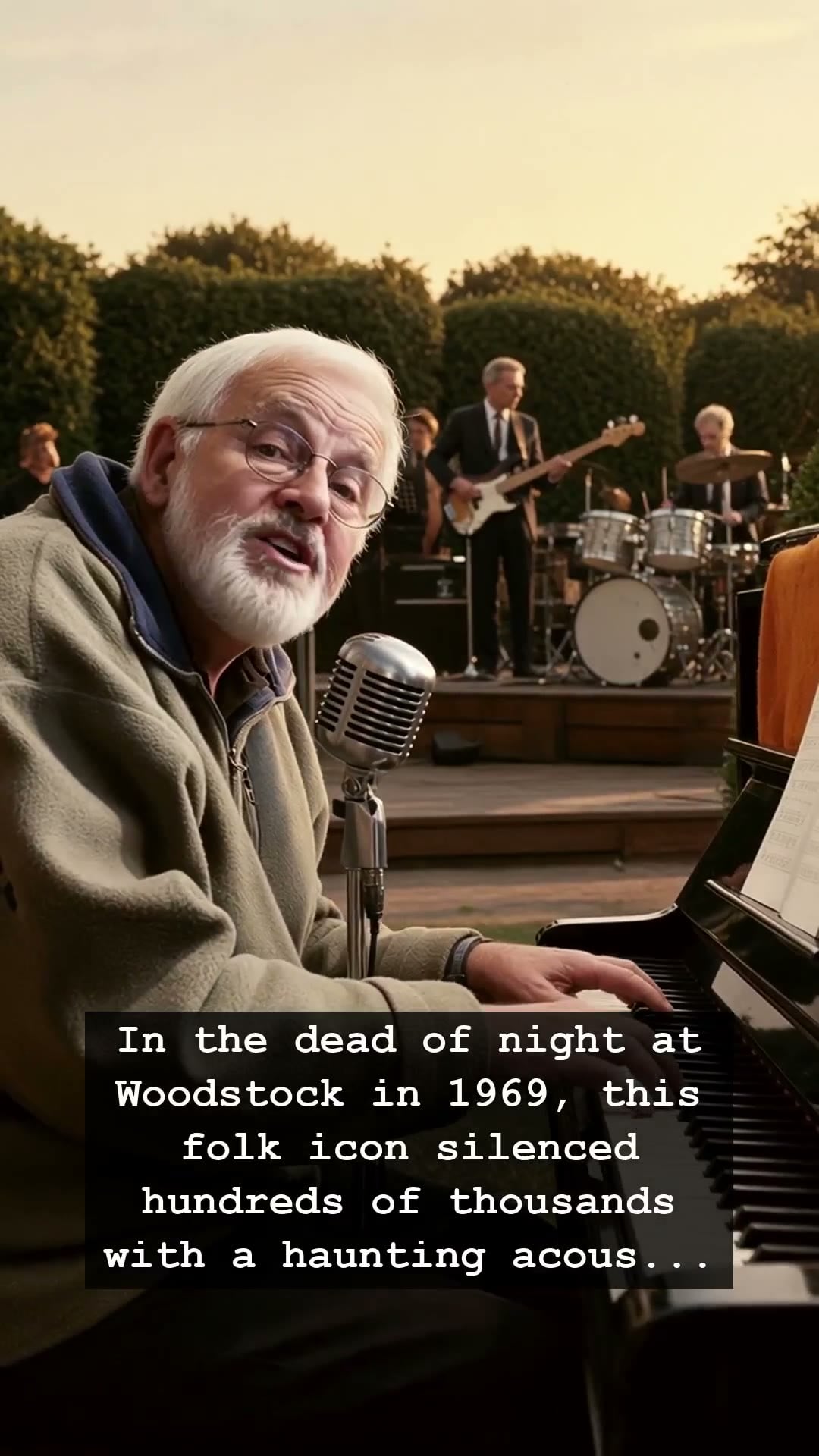
The year was 1969, and the air in Bethel, New York, was thick with the scent of wet earth, marijuana, and the collective anxiety of half a million souls. As the sun dipped behind the horizon at Woodstock, a sea of mud-caked hippies braced for the chaos of the night. Then, the madness momentarily vanished. Out of the darkness, a lone figure stepped onto the massive stage, clutching nothing but an acoustic guitar. Joan Baez, the fragile yet steel-willed queen of the folk revival, stood before the ocean of humanity and began to sing. In that suspended moment of silence, she didn’t just perform; she commanded the very atmosphere of a generation.
Joan Baez was no stranger to the spotlight, but this performance was different. Her voice, a crystalline soprano that could pierce through the thickest noise of the era, turned the sprawling, chaotic festival into an intimate parlor. She was six months pregnant at the time, navigating the immense pressures of the protest movement and her own complicated relationship with the counterculture icon Bob Dylan. The drama behind the scenes was as intense as the music itself; the establishment viewed the Woodstock gathering as a ticking time bomb, and Joan Baez carried the weight of that tension in every chord she struck that evening.
As she sang, the muddy fields of the Yasgur farm seemed to drift away. For those who were there, the experience was transcendent. Joan Baez possessed the rare ability to strip away the artifice of rock stardom, leaving only the raw, aching truth of the human condition. She was the voice of the Civil Rights movement and the anti-war sentiment, yet in the dead of night, she became something more ethereal. It was a haunting masterpiece that left hundreds of thousands breathless, a stark contrast to the electric, distortion-heavy sets that defined much of the festival.
This was the era of the Jukebox, the Vietnam protests, and the desperate search for meaning in a rapidly changing world. While many artists of the 1960s leaned into the psychedelic revolution and the noise of the electric guitar, Joan Baez remained anchored to the acoustic roots of American music. She bridged the gap between the protest anthems of the early decade and the impending disillusionment that would soon follow. Her performance that night served as a cultural anchor, reminding a fractured nation of the power of a single, unamplified human voice.
Decades later, the memory of her performance still resonates with those who cherish the soul of the 1960s. We look back at these moments not just as history, but as fragments of a dream that promised peace and delivered upheaval. Joan Baez remains a testament to the idea that true influence doesn’t always require a wall of amplifiers or a pyrotechnic display. Sometimes, it only takes a quiet melody under the stars to change the world. As we look back at the archives of our vinyl collections, we are reminded that some legends don’t fade; they simply wait for us to listen again.