
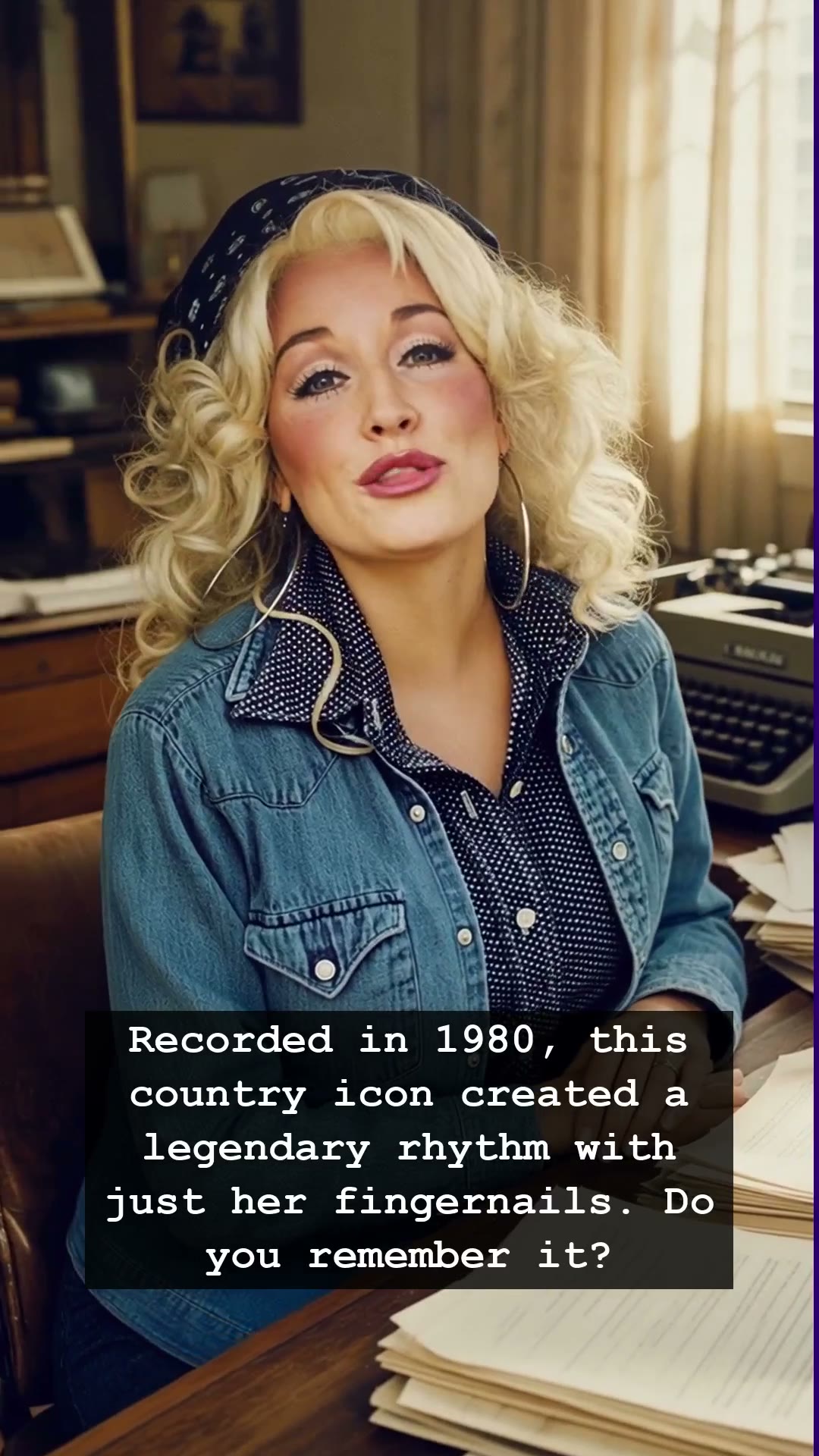
It was 1980, a time when the world was shifting from the disco-drenched excess of Studio 54 to the harsh, grinding reality of the modern American workplace. In the middle of this cultural transition, one country icon was about to inadvertently invent the beat of the working class. Dolly Parton, already a titan of Nashville, was on the movie set of the film 9 to 5, trying to capture the rhythmic anxiety of a buzzing office. While the producers looked for a percussionist to mimic the clatter of machinery, Dolly Parton stepped up and offered a bizarre, improvised solution: her own acrylic fingernails.
Most musicians look for drum kits or synthesizers to build a bridge between a melody and the listener, but Dolly Parton chose the simplicity of her own fingertips. She began tapping her long acrylic nails against each other, creating a crisp, clicking cadence that perfectly mimicked the relentless, staccato sound of a manual typewriter. It was a moment of pure genius born from necessity. The production crew was stunned, the engineers were captivated, and suddenly, the rhythm of the song wasn’t just a background track; it was the heartbeat of millions of women punching in and out of the corporate grind.
The resulting track became an anthem that defined an era. In an age where the Walkman was beginning to change how we consumed music on the go, Dolly Parton provided a soundtrack that felt as familiar as the office cubicle. This was no longer just a country tune; it was a societal shift set to music. The irony of using a fashion accessory to signify the drudgery of the 9-to-5 workday added a layer of grit and authenticity to the record that professional percussionists could never have replicated. It was organic, it was sharp, and it was undeniably Dolly.
Beyond the catchy melody, the success of the song highlighted the deep-seated exhaustion felt by the post-boom generation. Dolly Parton managed to turn a protest against workplace inequality into a radio-friendly smash. This was the magic of the era—taking the mundane elements of daily life, from the click of a typewriter to the chime of an office clock, and elevating them into legend. The song climbed the charts with a momentum that felt unstoppable, cementing Dolly Parton not just as a country singer, but as a voice for the everyman and everywoman.
Looking back, it is fascinating to realize how close we came to never hearing that signature beat. If Dolly Parton had not been fiddling with her nails that day on set, one of the most recognizable intros in pop culture history might have been lost to a generic drum machine. The sound remains a time capsule, taking us back to the early eighties, a time of big hair, bold ambitions, and the quiet revolution of the American worker. Even today, whenever that typewriter rhythm clicks into motion, you are immediately transported back to the golden age of pop-country storytelling. It reminds us that sometimes, the most iconic moments in music are born from the simplest of human gestures.