
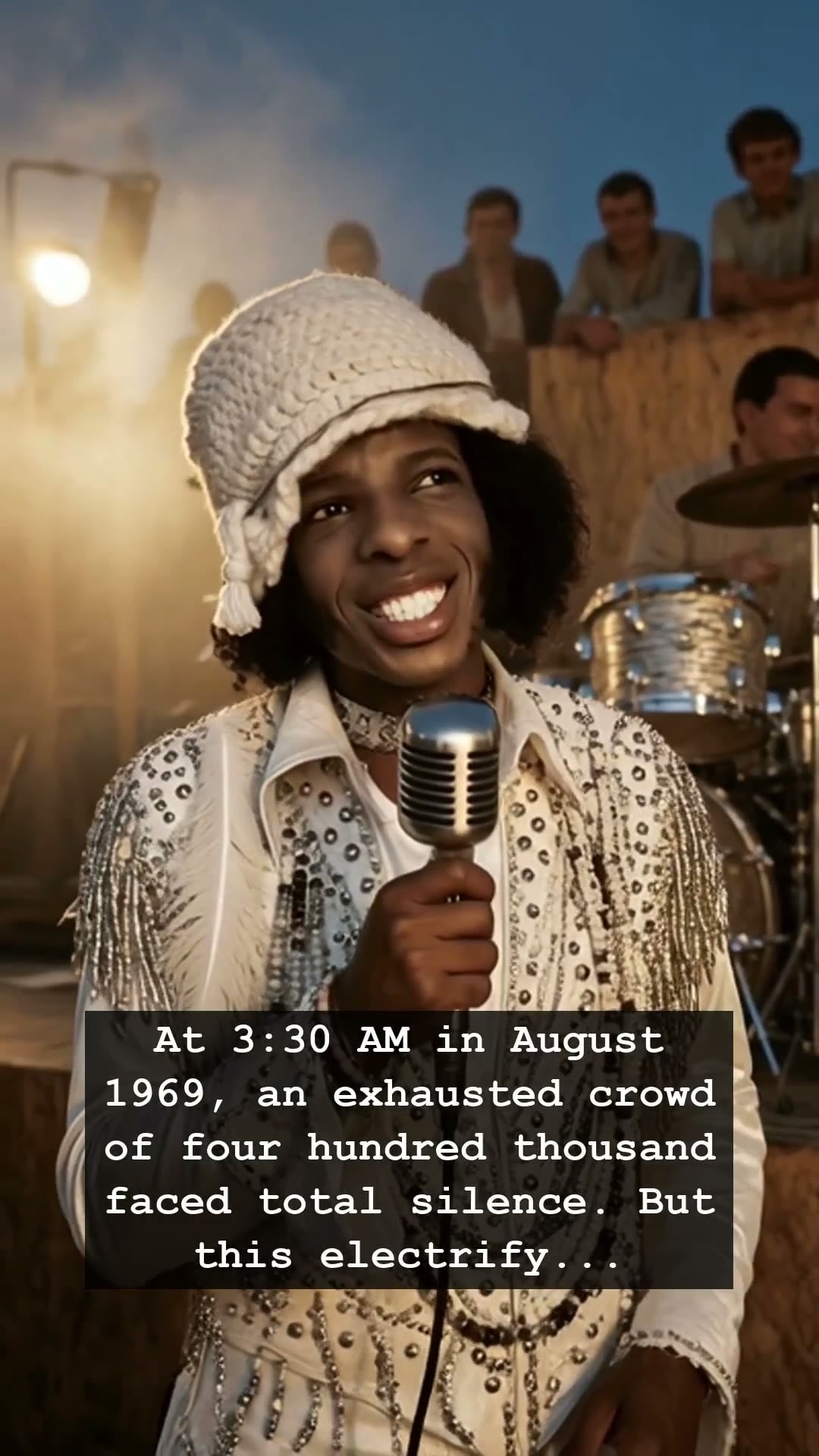
It was 3:30 AM in August 1969, and the air at Woodstock was thick with the scent of damp earth, fatigue, and the unspoken realization that a generation was pushing its limits. Four hundred thousand people were sprawled across the fields of Bethel, drifting into a collective, exhausted stupor as the midnight silence loomed heavy over the massive crowd. The festival had become a test of endurance, a sprawling city of mud and hope that seemed to be losing its momentum in the dark. Then, like a bolt of lightning cutting through the humid air, Sly Stone took the stage. With his signature platform boots, kaleidoscopic outfits, and a band that redefined the meaning of groove, he didn’t just play music; he commanded the atmosphere to wake up.
Sly Stone was the catalyst that the exhausted masses didn’t know they needed. As the first notes of Higher resonated through the humid night, the lethargy vanished, replaced by a seismic surge of energy. This was not merely a performance; it was a rhythmic exorcism. Sly Stone managed to transform the sleepy, muddy darkness into the largest and most exhilarating funk dance party in human history. For a few glorious hours, the chaos of the festival faded, replaced by the unified pulse of a crowd moving as one body, driven by the revolutionary sound of Sly and the Family Stone.
To understand why this moment remains a cornerstone of American music history, one must look at the duality of Sly Stone himself. He was a visionary who bridged the gap between soul, funk, and psychedelic rock, effectively dismantling the racial and sonic barriers of the late sixties. However, the tragedy of his narrative is as potent as his genius. The same man who could mobilize half a million people into a joyous frenzy would soon find himself retreating into the shadows of substance abuse and professional isolation. The high of that Woodstock morning was followed by the slow, painful unraveling of a band that had once represented the peak of cultural integration and musical innovation.
Beyond the glitz of the era, the story of Sly Stone is a cautionary tale of the dark side of fame. His descent from the stage to the seclusion of his later years mirrors the transition of the music industry itself—from the communal euphoria of Woodstock to the cynical, drug-fueled excesses that defined the early seventies. Yet, when we think back to that fleeting, golden age of the jukebox and the open road, the image of him bathed in stage lights remains untarnished. It stands as a testament to the power of a single artist to dictate the mood of a nation.
Decades later, the echoes of his funk still vibrate through our modern musical landscape. Sly Stone remains a ghost of our collective memory, a symbol of a time when music felt like a revolution. We hold onto these moments—the late-night sets, the crackle of a vinyl record, the nostalgia for a world that felt both more dangerous and more alive. As the lights dim on those legendary nights, we are left wondering if we will ever see such raw, untethered musical brilliance again. Do you remember where you were when the funk took over?