
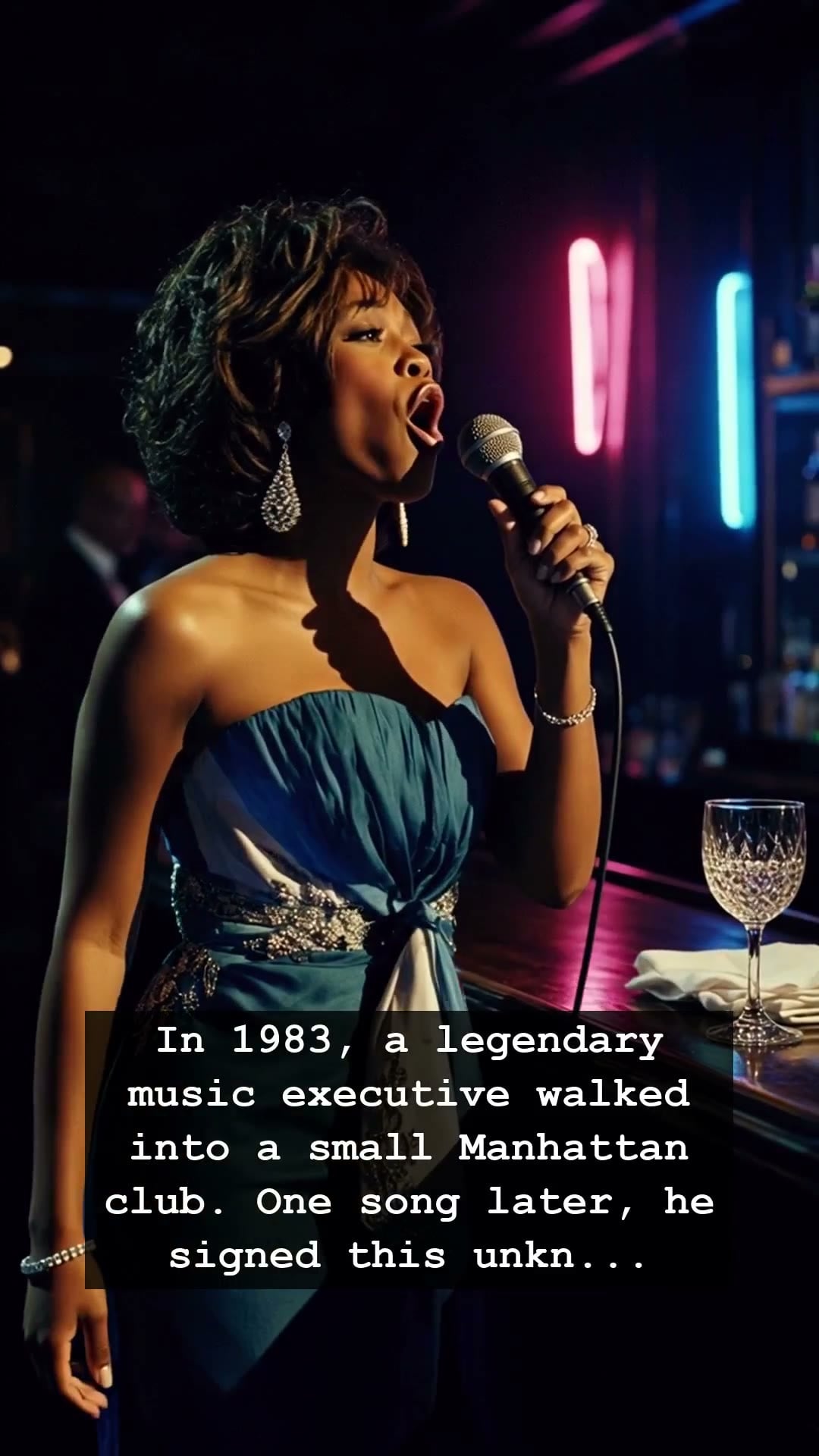
The air in that dimly lit Manhattan club in 1983 was thick with the scent of cheap perfume and stale cigarettes, a typical backdrop for the gritty New York music scene of the early eighties. Nobody in the room expected to witness a miracle. Yet, when a nineteen-year-old girl stepped onto that cramped, makeshift stage, the chatter died down instantly. It was Whitney Houston, an unknown talent with a gaze that held both vulnerability and an unshakable, quiet confidence. She opened her mouth to sing, and for those few minutes, time itself seemed to suspend. A legendary music executive sat in the shadows, his drink forgotten, watching as a star was born in real-time. By the time she hit the final note, the contract was essentially written in the air.
That night, Whitney Houston was not just a singer; she was a force of nature. This was the era of the burgeoning MTV generation, a time when the visual spectacle was beginning to demand as much attention as the vocal performance. Yet, Whitney Houston possessed a raw, gospel-infused power that bypassed the need for gimmicks or flashy synthesizers. Her voice was a cathedral of sound, a perfect instrument that felt timeless against the backdrop of an era defined by neon lights, the rising popularity of the Walkman, and the rapid evolution of pop radio. She brought a sense of soul and depth that anchored a decade often criticized for being all style and no substance.
Behind the curtains of that legendary debut, the machinery of the industry was ready to explode. Whitney Houston was a product of a musical pedigree, raised in the church and sharpened by the grueling expectations of high-end club circuits. While her peers were focused on the dance-heavy trends of the mid-eighties, she was preparing to become a global phenomenon. However, the weight of that transition was heavy. The same industry that embraced her voice also demanded total perfection, turning her into a commodity in an era where the public appetite for celebrity secrets was just beginning to hit a fever pitch. The tragedy and the triumph were often two sides of the same golden coin.
Even today, the echo of that 1983 discovery remains a haunting reminder of what pure, unadulterated talent looks like before it is packaged for the masses. When we look back at the archives of the music industry, few moments feel as seismic as that club performance. Whitney Houston became the voice of a generation, setting a bar for vocal excellence that artists are still desperately trying to clear four decades later. She represented the transition from the old soul guard into the hyper-polished world of modern pop, yet she never lost that visceral, spiritual connection to the music that first captivated that room in Manhattan.
Her story remains a beautiful, tragic testament to the price of brilliance. As we listen to those iconic tracks today, we aren’t just hearing a song; we are revisiting the ghost of a nineteen-year-old girl who didn’t know she was about to change the world. Whitney Houston remains an eternal emblem of musical greatness, a soaring reminder of a night when a smoky club became the stage for a legend who would define our collective memory for decades to come.