
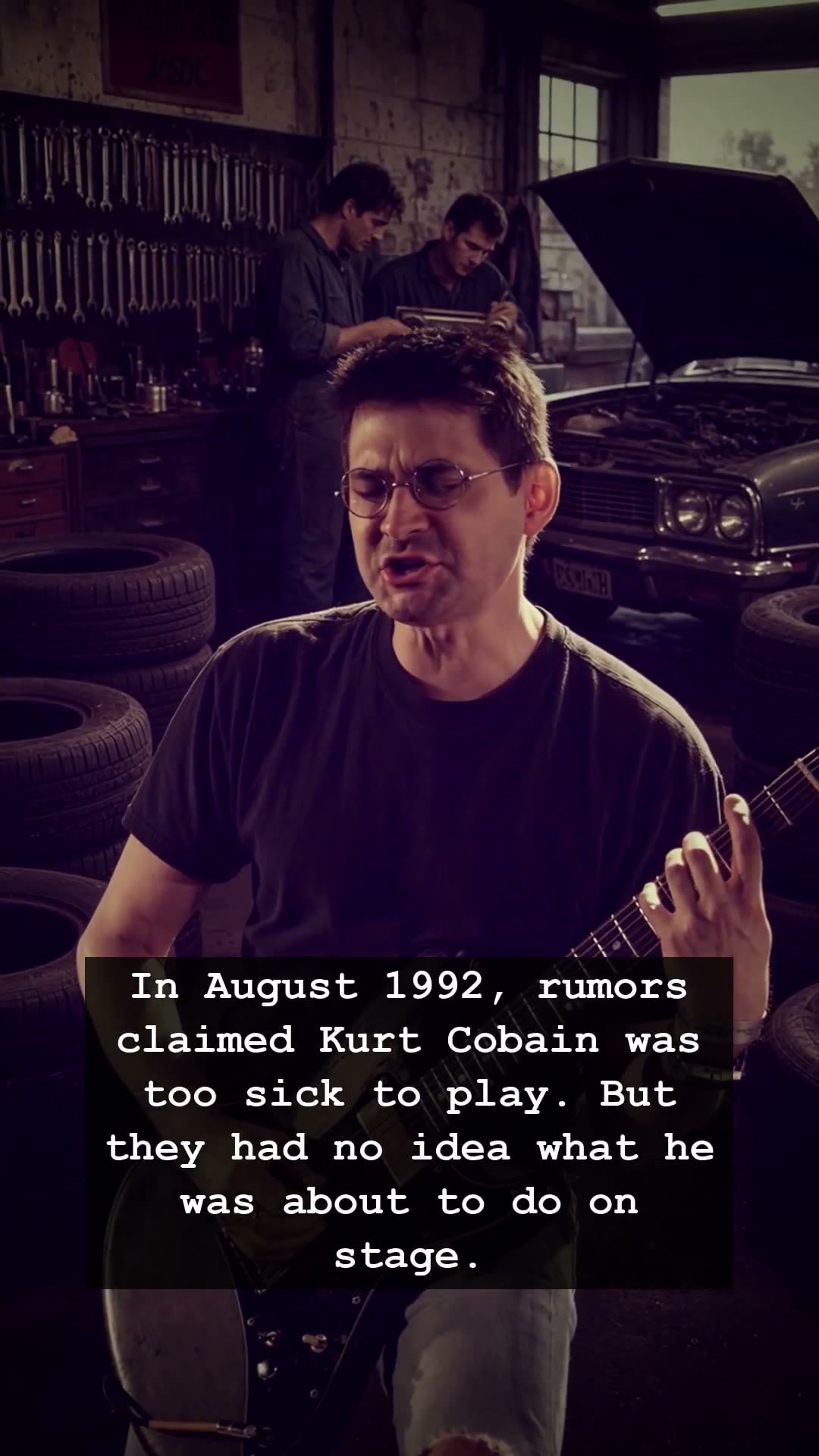
It was August 1992, and the music industry was holding its collective breath. Rumors had been swirling through the underground scene like wildfire: Kurt Cobain, the reluctant prophet of the Grunge movement, was supposedly too sick, too frail, and too unstable to perform. The tabloids, hungry for a tragedy, practically had his obituary written. As the Reading Festival crowd gathered, a sense of heavy anticipation hung over the field. People expected a disaster, a ghost of a man unable to face the blinding lights of stardom. But then, the stage lights flickered, and the legend took a turn that nobody saw coming.
Instead of walking out, Kurt Cobain was wheeled onto the stage in a hospital gown, hunched over in a wheelchair, mocking the very media machine that sought to dismantle him. With a slow, theatrical rise, he stood up, let out a piercing scream, and dived headfirst into the sonic chaos of Nirvana. It was a masterclass in defiance. The raw energy of the performance silenced the critics instantly. For the thousands jammed into that muddy field, it was no longer just a concert; it was an act of survival. This moment captured the essence of the early 90s, where the glossy, synthetic pop of the previous decade finally collapsed under the weight of genuine, unwashed human emotion.
That night in Reading remains etched in cultural history as the moment Nirvana truly solidified their grip on a generation. While the MTV era was busy packaging rebels for mass consumption, Kurt Cobain was busy dismantling the facade from within. He struggled openly with the physical toll of fame, the crushing expectations of being a reluctant icon, and the deep, haunting shadows that followed him offstage. The hospital gown wasn’t just a costume; it was a middle finger to the industry that viewed his health as a commodity and his misery as a marketable aesthetic. He reclaimed his narrative by turning his own vulnerability into a weapon.
The Reading 1992 performance is a testament to the power of the Grunge movement, a genre that favored feedback and honesty over the polished perfection of 80s arena rock. Even today, the grainy footage of that night carries an electric charge. It reminds us of a time before the instant gratification of the internet, when music lived in the physical vibrations of a crowd and the unpredictable volatility of its performers. Watching Kurt Cobain that night, one realizes he was never just playing music; he was fighting a war against the expectations placed upon his soul.
Decades later, the legend of Kurt Cobain continues to grow, attracting new fans who crave authenticity in an increasingly filtered world. He remains the patron saint of the misunderstood, a man who gave his all until there was nothing left to give. Whenever we look back at the archives of rock history, we find ourselves drawn back to that summer night in England. It serves as a poignant reminder that even when we are at our weakest, we have the power to create something that outlasts the darkness. If you listen closely, you can still hear the roar of the crowd and the unmistakable howl of a legend who refused to be broken.